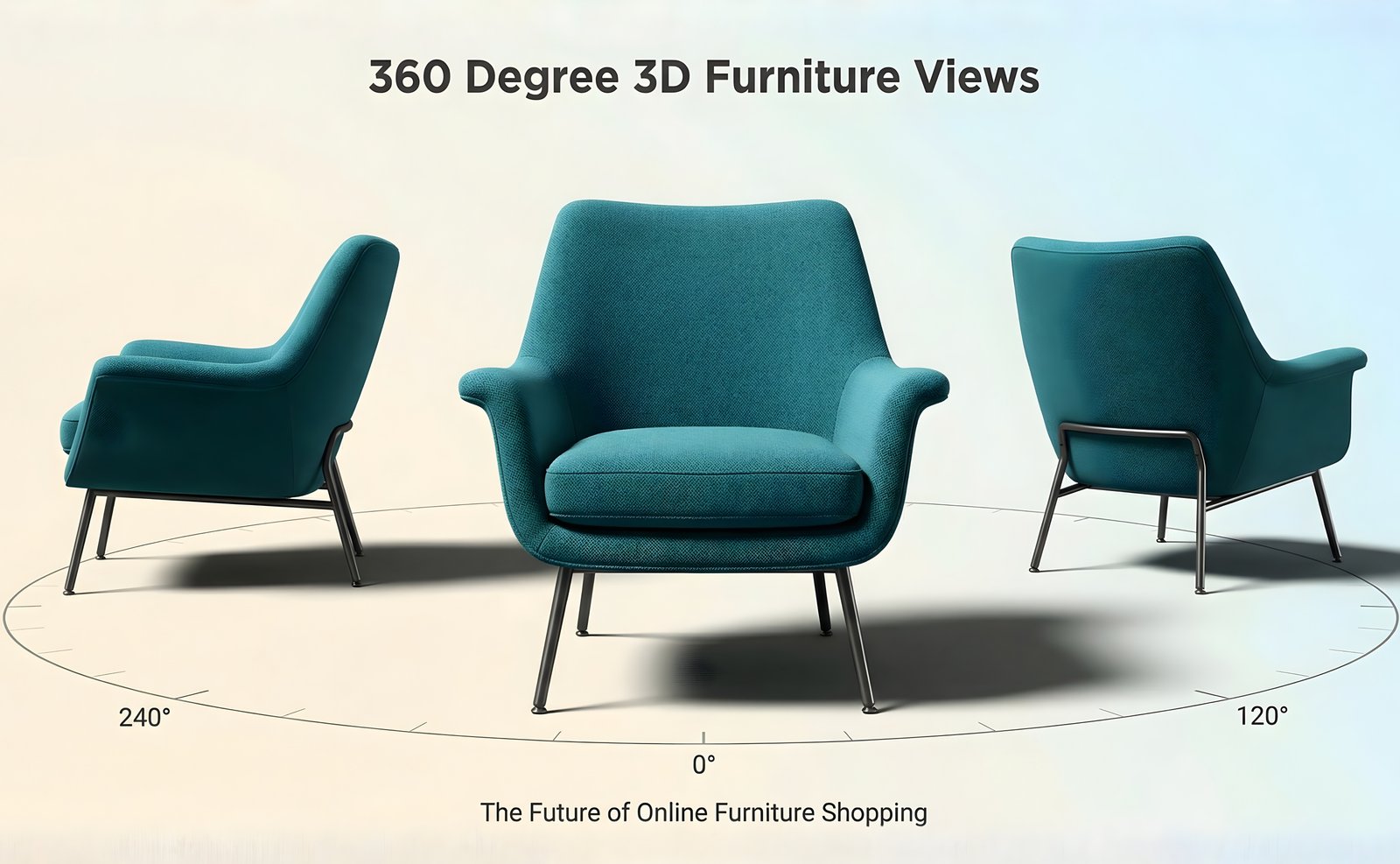
The way consumers shop for furniture has fundamentally changed. Gone are the days when a simple grid of static images was enough to close a sale. Today, your customers demand an interactive shopping experience that bridges the gap between the digital screen and the physical showroom. This is where 360 furniture rendering steps in not just as a visual upgrade, but as a critical business solution.
For online retailers, the challenge has always been replicability. How do you replicate the confidence a customer feels when they touch a velvet sofa or walk around a dining table in a brick-and-mortar store? The answer lies in immersive technology. By integrating high-quality 3D product view technology, you are not merely showing a product; you are solving the primary problem of e-commerce: uncertainty.
The “Touch and Feel” Gap: Why Static Images Are Failing
First, we must address the elephant in the room. Traditional photography, while useful, is increasingly inadequate for high-ticket items like furniture. When a customer views a static image, they are often left with questions. What does the back of this armchair look like? Will the texture of this wood grain match my flooring? Is the scale accurate?
These unanswered questions lead to “cart abandonment.” In fact, hesitation caused by a lack of visual information is one of the top reasons shoppers leave without buying. Furthermore, if they do buy but the product doesn’t match their mental image, it leads to returns. Returns are the silent killer of profit margins in the furniture industry.
However, there is a clear solution. By utilizing 360 furniture rendering, you effectively remove the blinders. You empower your customers to spin, zoom, and inspect every inch of a piece. Consequently, this transparency builds the trust necessary to commit to a purchase.
How 360 Furniture Rendering Solves the Return Problem
Reducing return rates is arguably the most significant financial benefit of adopting 3D visualization. When customers interact with a 3D product view, they gain a comprehensive understanding of the item’s proportions and features.
Providing Accurate Visual Expectations with 360 Views
Unlike a staged photo that might hide a flaw or an awkward angle, a 360 furniture rendering lays everything bare. It allows the shopper to verify the quality of the joinery, the flow of the fabric pattern, and the structural integrity of the design.
Because the customer has “inspected” the product virtually, the item that arrives at their doorstep matches their expectations perfectly. Therefore, the likelihood of a return due to “item not as described” drops precipitously. This is a direct problem-solution dynamic: better visuals equal fewer returns, which equals higher net revenue.
Enhancing the Mobile Shopping Experience with 3D Models
Moreover, we cannot ignore the mobile shopper. A significant portion of e-commerce traffic now comes from smartphones. On a small screen, scrolling through dozens of static photos is tedious. Conversely, an interactive 3D product view is intuitive and engaging. A simple swipe allows a user to rotate a sofa 360 degrees. This level of interactivity keeps users on your page longer, signaling to search engines that your content is valuable, which indirectly boosts your SEO.
Accelerating Business Growth Through Interactive Experiences
Beyond solving problems, 360 furniture rendering is a catalyst for aggressive business growth. It positions your brand as a forward-thinking leader rather than a follower.
Boosting Conversion Rates with Immersive Interaction
The math is simple: the longer a customer interacts with a product, the more likely they are to buy it. Interactive content is “sticky.” It captures attention in a way that passive images cannot. When a user actively controls the view—spinning the chair, zooming in on the texture—they feel a sense of ownership over the experience. This psychological connection significantly increases conversion rates.
Data consistently shows that product pages featuring 360 furniture rendering outperform those without. It is an investment that pays for itself by turning passive browsers into confident buyers.
Streamlining Marketing and Prototyping
Another often-overlooked business benefit is the versatility of 3D assets. Once you have a high-quality 3D model created by a studio like Blue Ribbon 3D, you can use it for more than just your website.
For instance, these assets can be used for:
Augmented Reality (AR): allowing customers to project the furniture into their own living rooms.
Social Media Marketing: creating engaging video content where the furniture spins or disassembles.
Virtual Prototyping: testing new colors or fabrics without manufacturing a physical sample.
This flexibility reduces your marketing and R&D costs, further widening your profit margins.
The Future is Immersive: Don’t Get Left Behind
As we look toward the future, the standard for online shopping will only get higher. 3D visualization is rapidly moving from a “nice-to-have” feature to a baseline expectation. Competitors who fail to adopt 360 furniture rendering risk appearing outdated and trustworthy.
Furthermore, as Virtual Reality (VR) and the metaverse continue to evolve, having a library of 3D-ready assets will effectively future-proof your business. You will be ready to deploy your catalog into virtual showrooms while your competitors are still scheduling photo shoots.
Choosing the Right Partner for 3D Product Views
Implementing this technology might seem daunting, but it doesn’t have to be. Partnering with a specialized animation studio like Blue Ribbon 3D ensures that your transition to 3D is seamless. Whether you need photorealistic textures, smooth 360-degree rotations, or complex interactive tours, professional expertise is key to getting results that actually convert.
Conclusion
In conclusion, the shift towards 360 furniture rendering is not a passing trend; it is the natural evolution of e-commerce. It solves the critical problems of trust and returns while simultaneously opening new avenues for business growth and customer engagement.
If you are ready to elevate your online store and offer a truly interactive shopping experience, the time to act is now. By embracing 3D product view technology, you are not just selling furniture; you are providing a modern, confidence-inspiring service that today’s shoppers demand.
