Introduction
If you are planning a furniture catalog shoot for 2026, furniture 3D rendering cost is probably the first number you need before anything else gets approved. Budgets, timelines, and vendor comparisons all start with this one question: what will each rendered image actually cost?
The honest answer depends on format, detail level, and volume. But real 2026 market ranges exist, and this guide lays them out clearly, with no vague “contact us for pricing” dead ends.
At Blue Ribbon 3D, we quote furniture brands every week, so the numbers below reflect what studios are actually charging in 2026, not rough guesswork. By the end, you will know what to budget, what drives the price up or down, and how to compare quotes properly.
| Direct Answer Furniture 3D rendering cost in 2026 typically ranges from $50 to $400 per image, depending on the format. A basic silo image on a white background sits near the lower end, while a full lifestyle scene, animation, or AR-ready model costs more. Most studios offer volume discounts once a brand orders 20 or more products. |
Key Takeaways
- Furniture 3D rendering typically costs $50–$400 per image, versus $500–$1,500 per day for a traditional photo shoot.
- Silo images are the cheapest format; animation and AR models cost the most.
- Volume pricing usually kicks in around 20+ products, lowering the per-unit cost significantly.
- No physical sample is required — CAD files or accurate dimensions are enough to get a quote.
- The cheapest quote is not always the best value — check revision policy and reuse pricing before signing.
At a Glance: 2026 Furniture 3D Rendering Pricing
| Format | Typical Price (USD) |
| Silo image (white background) | $50 – $150 per image |
| Lifestyle scene (room setting) | $100 – $300 per image |
| 360° rotating view | $150 – $350 per product |
| AR-ready model | $200 – $500 per product |
| Animation / video | $300 – $1,200 per video |
What Determines Furniture 3D Rendering Cost?
The 3D rendering cost per image you get quoted depends on five main variables, and understanding them helps you avoid paying for detail you don’t actually need.
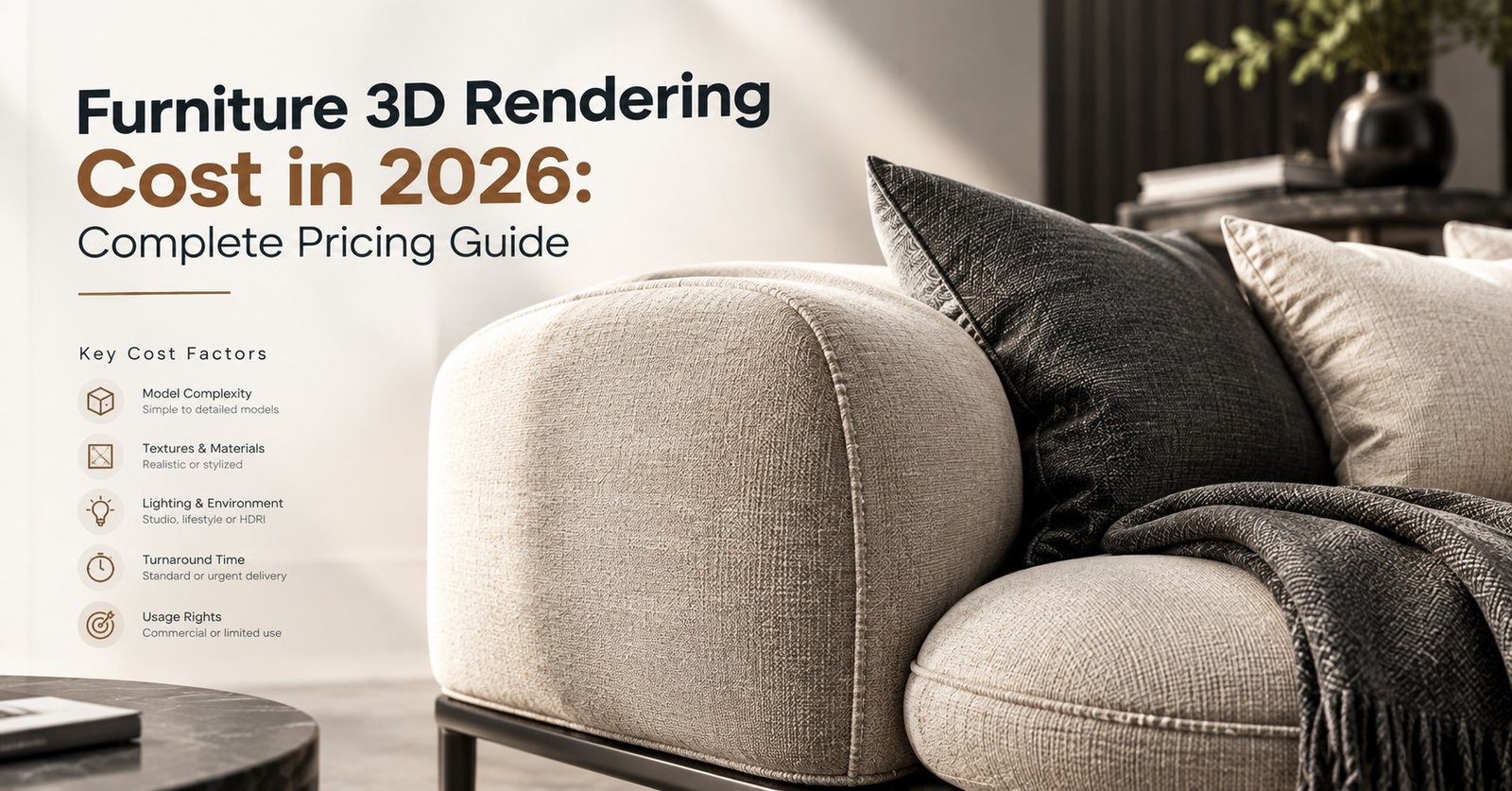
- Model complexity: a simple accent chair costs less to build than a modular sectional sofa with multiple configurations.
- Material detail: realistic fabric weave, leather grain, or wood texture takes longer to render than a flat matte finish.
- Number of angles or colorways: each additional camera angle or color variant adds a small incremental cost on top of the base model.
- Turnaround speed: rush delivery, especially under 48 hours, usually carries a premium over standard timelines.
- Order volume: per-image pricing drops noticeably once a brand commits to a full catalog instead of a handful of SKUs.
It’s worth noting that furniture presents unique modeling challenges compared to simpler product categories. Upholstered pieces need convincing fabric drape and seam detail, while wood furniture needs grain direction that matches how the piece is actually manufactured — both of which take more artist time than a rigid plastic or metal product would.
How Does Furniture 3D Rendering Pricing Work in the USA?
For brands searching specifically for furniture rendering price USA, the pricing model works the same way globally, but a few USA-specific factors shape the final quote.
Most studios serving the US furniture market quote in USD and price per finished image rather than per hour, which makes budgeting far more predictable than a traditional day-rate photography quote.
US brands also tend to request marketplace-specific formats more often, since Amazon, Wayfair, and Target Plus each enforce their own image background and sizing rules. A studio that already understands these requirements can save a brand from costly rework after a listing gets rejected.
Time zone overlap matters too. Studios that offer at least a few working hours of overlap with US business hours typically turn around revision requests faster, which shortens the overall project timeline even when the base price is similar.
Currency and payment terms are worth confirming as well. Some overseas studios quote in USD but settle in a different currency, which can shift the final cost slightly if exchange rates move between the quote and the invoice date.
Benefits of Knowing Your 3D Rendering Costs Upfront
A clear 3D product rendering pricing guide does more than help you pick a vendor. It changes how you plan the entire visual production calendar for the year.
- Accurate budgeting: you can forecast the full-catalog cost before committing to a single product.
- Easier vendor comparison: knowing typical market ranges makes it obvious when a quote is unusually high or suspiciously low.
- Better internal buy-in: finance and marketing teams approve budgets faster when the numbers are backed by real ranges, not guesses.
- Room to scale: understanding volume discounts lets you plan a phased rollout instead of an all-or-nothing catalog switch.
Red Flags to Watch for in a Low Quote
A quote that looks unusually cheap compared to the ranges above is not automatically a bargain. A few warning signs are worth checking before you sign.
- No mention of revisions: if the quote doesn’t specify how many revision rounds are included, assume it means zero or one.
- Unusually long turnaround for a low price: a two-week wait for a “discount” render often signals an overloaded or understaffed studio.
- No sample portfolio in your exact category: furniture rendering has specific challenges — fabric, wood grain, upholstery — that a general product studio may not handle well.
- Full payment required upfront: most established studios split payment across a deposit and final delivery, which protects both sides.
Cost of 3D Rendering vs. Photography
The cost of 3D rendering vs photography comparison is where most brands find the clearest financial case for switching.
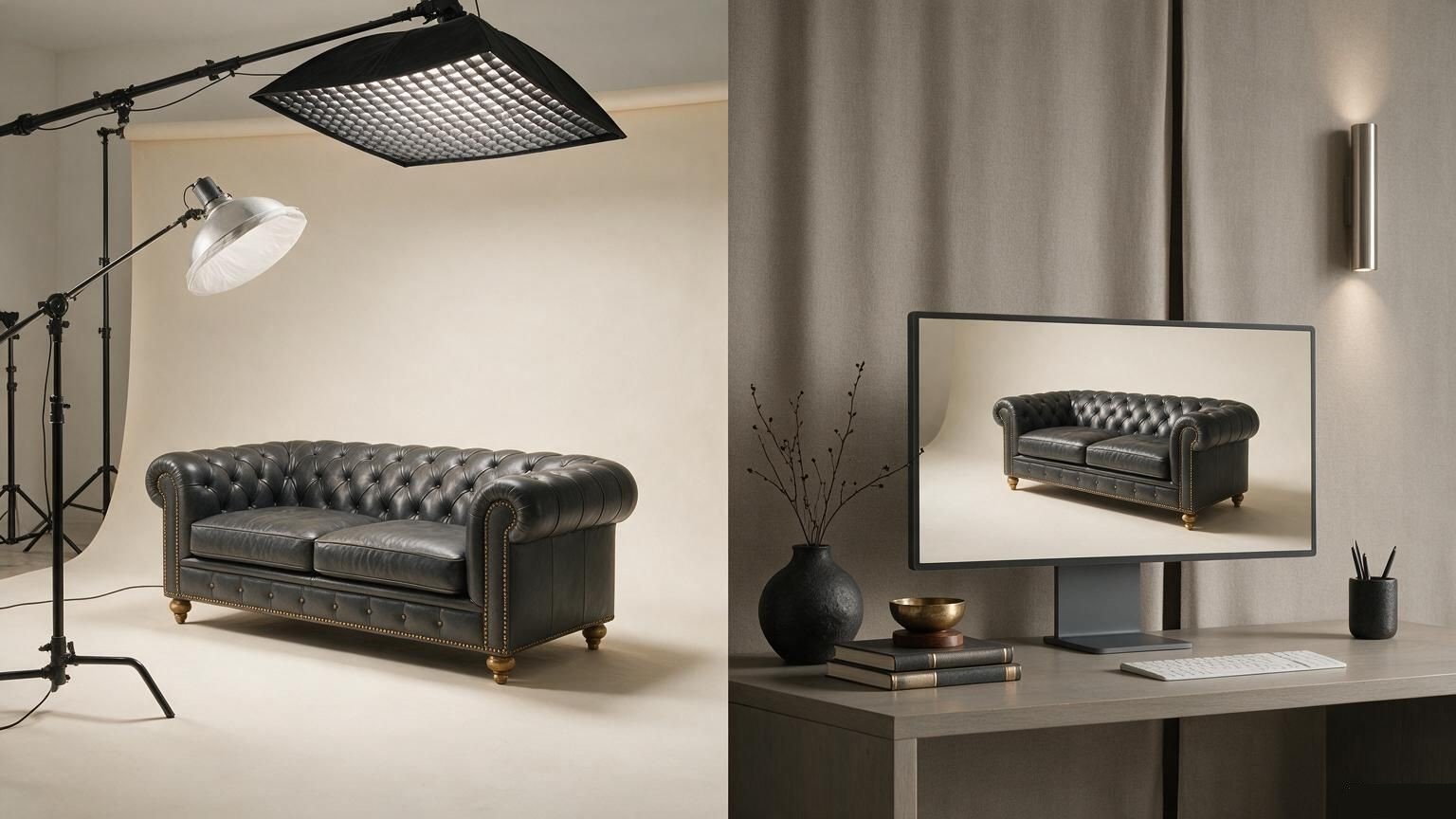
A single studio photo shoot often costs $500 to $1,500 per day once you add studio rental, styling, and post-production editing. For a handful of products, that can exceed $3,000 in a single session, and every new colorway means booking another shoot.
| Factor | 3D Rendering | Traditional Photography |
|---|---|---|
| Typical cost | $50 – $400 per image | $500 – $1,500 per day |
| New color variant | Low — re-texture the model | High — full reshoot needed |
| Physical sample needed | No | Yes, every time |
| Turnaround | 2 – 5 business days | Days to weeks, incl. samples |
| Reusable for AR/360°/animation | Yes, same asset | No, separate capture required |
Independent return-rate research backs up part of this case: the 2025 NRF and Happy Returns benchmark found that online shoppers returned roughly one in five purchases, and inaccurate product expectations are a well-documented driver of those returns. Better visual accuracy before checkout is one of the more direct ways to chip away at that number.
Furniture 3D Rendering Services Pricing by Format
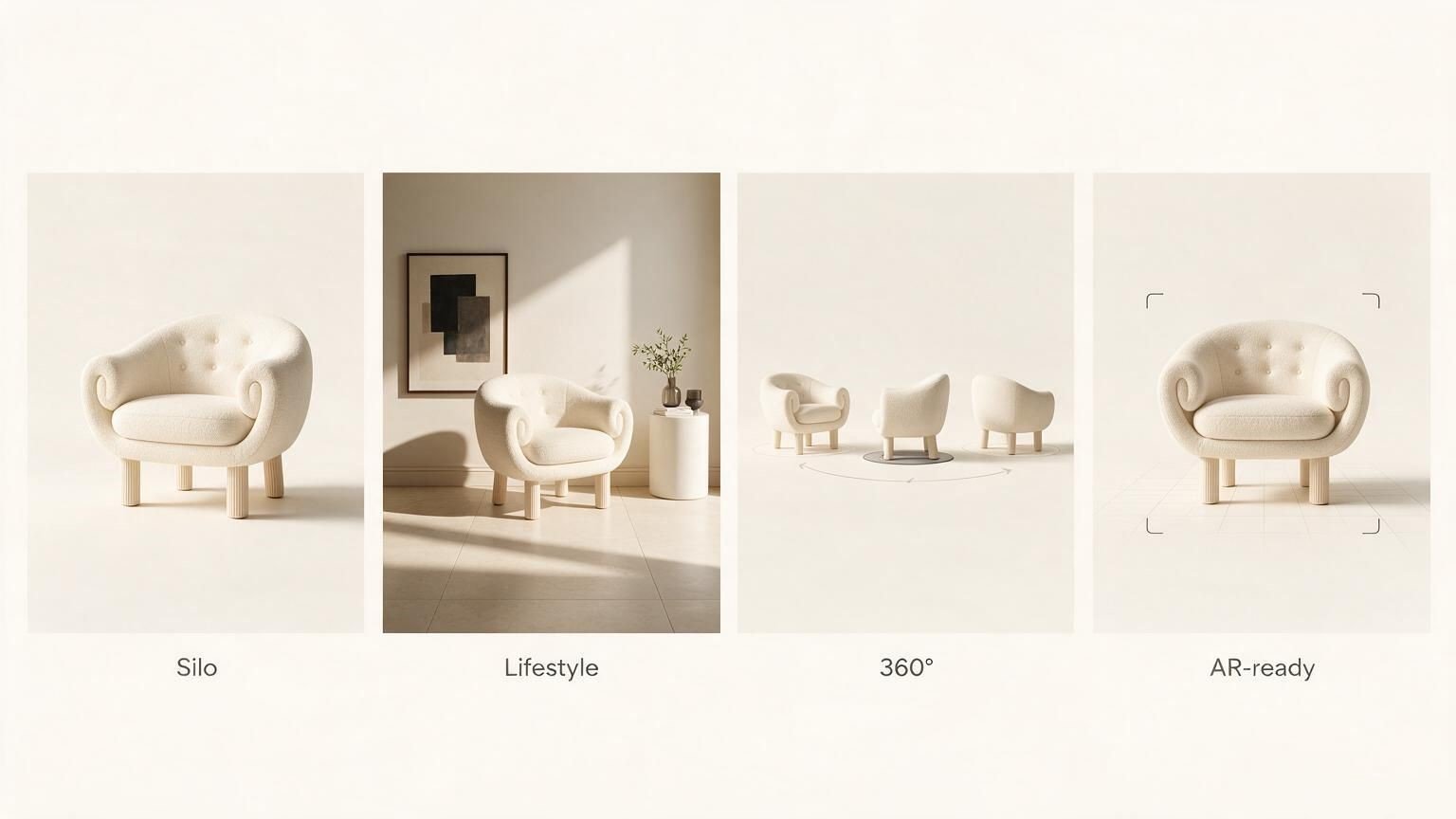
Not every product needs every format. Here is what furniture 3D rendering services pricing typically looks like broken down by output type, so you can match spend to what your storefront actually needs.
| Service | Typical Cost | Best Used For |
| Silo image | $50 – $150 | Marketplace listings, catalogs |
| Lifestyle scene | $100 – $300 | Website hero images, ad creative |
| 360° rotating view | $150 – $350 | Product detail pages |
| AR-ready model | $200 – $500 | Mobile app room-preview features |
| Animation / video | $300 – $1,200 | Social ads, video marketing |
Sample Project Profile: Budgeting a Mid-Size Catalog
Here is a representative example based on typical project scopes we see, to make these ranges concrete rather than abstract. This is an illustrative profile, not a specific named client engagement.
A mid-size furniture brand launching 50 new SKUs wanted silo images for every product, lifestyle scenes for its 20 bestsellers, and short animations for its 5 hero pieces.
| Line Item | Quantity | Estimated Cost |
| Silo images | 50 products | $2,500 – $7,500 |
| Lifestyle scenes | 20 products | $2,000 – $6,000 |
| Animations | 5 videos | $1,500 – $6,000 |
| Estimated Total | — | $6,000 – $19,500 |
In this scenario, the brand’s actual cost landed closer to the lower end of the range once volume pricing applied across all 50 SKUs, which is typical once an order crosses the 20-product threshold most studios use as a volume-pricing cutoff.
Affordable 3D Rendering Options for Furniture Brands
Budget constraints don’t have to mean skipping 3d furniture rendering services altogether. Several affordable 3D rendering for furniture brands strategies keep quality high while controlling spend.
- Start with silo images only: the cheapest format still meets most marketplace listing requirements.
- Pilot with bestsellers: render your top 10–20 SKUs first, then reinvest savings into scaling the rest of the catalog.
- Reuse the base model: ask your studio for reuse pricing on future colorways instead of paying full price again.
- Batch your order: submitting 20+ products in one request usually unlocks volume pricing versus ordering piecemeal.
None of these approaches require sacrificing quality. They simply sequence the spend so a brand can prove the return on investment on a small batch before committing the full catalog budget.
Frequently Asked Questions
What is the average furniture 3D rendering cost?
Most furniture 3D renders cost between $50 and $400 per image in 2026, depending on the format and level of detail required, with volume discounts common for larger catalogs.
How much does 3D furniture rendering cost per image?
A basic silo image typically costs $50 to $150, while a detailed lifestyle scene runs $100 to $300 per image, and pricing usually drops as order volume increases.
Why does 3D rendering cost vary so much between studios?
Pricing varies based on studio experience, model complexity, revision policy, and how many output formats are included in the base quote, so always compare like-for-like scopes.
Is 3D rendering cheaper than hiring a photographer?
Usually yes. A single photography day can cost $500 to $1,500, while a comparable batch of 3D renders often costs a fraction of that per product, especially across multiple color variants.
When should I request a volume discount?
Most studios apply volume pricing once an order reaches around 20 products, so batching your catalog into one request is worth it rather than ordering piecemeal.
How do I compare 3D rendering quotes fairly?
Compare the exact same format, revision count, and turnaround time across quotes — a lower price with fewer revisions or a longer timeline may cost more in the end.
Do US furniture brands pay more for 3D rendering?
Not necessarily. Many studios serving the US market quote in USD at similar rates to the global market, though marketplace-specific formatting may add a small cost.
Can I get an affordable 3D rendering package as a small brand?
Yes. Starting with silo images for a handful of bestsellers is the most affordable entry point, with room to scale as budget and results allow.
Conclusion
Furniture 3D rendering cost in 2026 is far more predictable than most brands expect going in. Prices scale clearly with format and volume, which makes budgeting easier than planning a traditional photo shoot from scratch.
The brands getting the best value aren’t always paying the least per image — they’re the ones scoping the project clearly upfront and choosing a partner who prices model reuse fairly.
Use the ranges in this guide as your starting benchmark, then request itemized quotes from two or three studios before committing. A clear apples-to-apples comparison, format by format, will tell you far more than any single studio’s marketing page.
Ready to see real numbers for your own catalog? Blue Ribbon 3D provides transparent, itemized quotes for furniture brands planning their 2026 visual budget
Related posts
3D Furniture Rendering: How Furniture Brands Are Using 3D Visualization to Sell Online in 2026
Introduction Furniture brands no longer rely only on studio photography to sell online. 3D Furniture …
How 3D Furniture Rendering Services Are Transforming Online Furniture Shopping in the USA in 2026
Introduction Buying furniture online used to feel risky. Shoppers couldn’t touch the fabric or …