
Introduction
Buying 3D furniture rendering services USA should feel simple. Send a product. Receive photoreal images. In practice, many buyers feel lost at the quote stage.
Studios use different terms. Prices vary widely. Image specs change by sales channel. A quote that looks cheap can hide extra fees for revisions, variants and file formats.
At Blue Ribbon 3D, we answer these questions every week. This guide gives you the specs to ask for, the services worth knowing, realistic price ranges and a simple way to compare studios.
| Quick Answer 3D furniture rendering services in the USA turn CAD files, drawings or samples into photoreal images, 360° views, animations and AR models. Published 2026 market ranges run roughly $40 to $150 for a white-background image and $150 to $500 for a lifestyle scene. Final price depends on model complexity, variants, revisions, volume and turnaround. |
Key Takeaways
- Specs matter as much as price. Check resolution, background and file formats first.
- Modeling is often the largest cost in a first project. Clean CAD files lower it.
- Extra fabrics and finishes cost far less than the first image.
- Ask for a test render before you commit to a full catalog.
- One master model can power images, 360° views, animation and AR.
At a Glance: Typical 2026 Market Ranges
| Deliverable | Typical use | Approximate market range |
| White-background image | Catalog, marketplace listings | $40–$150 per image |
| Lifestyle scene | Website, ads, social | $150–$500 per image |
| 360° view or configurator asset | Product pages | $500–$2,000 per product |
| Extra colour or fabric | Variants of a modeled product | About 20%–40% of the first image |
| Rush delivery | Urgent launches | Adds about 25%–50% |
What Are 3D Furniture Rendering Services in the USA?
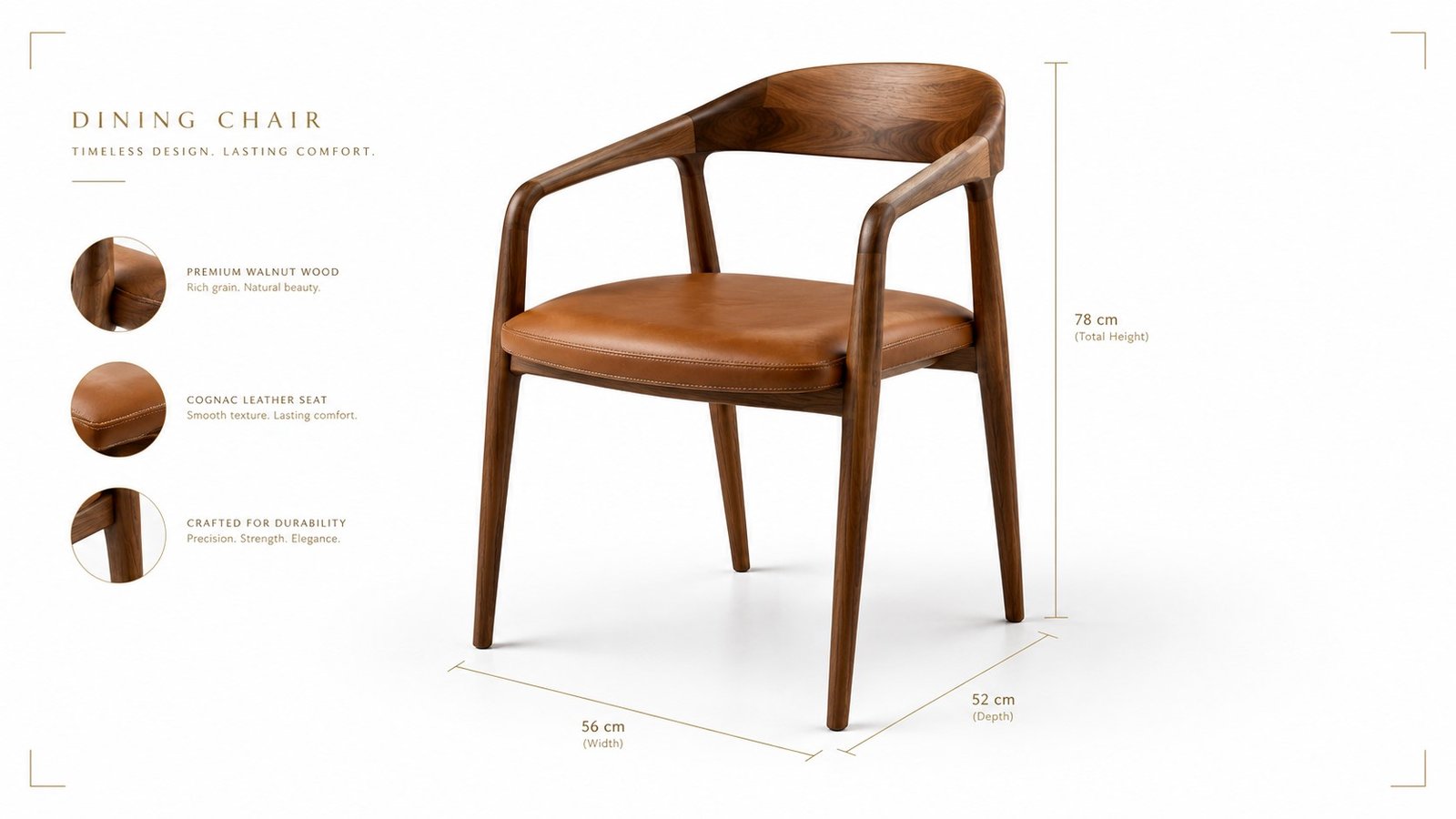
These services create furniture images without a camera. A studio builds an accurate 3D model of your product. Artists then add real materials, light and a scene, and render the final image.
The industry also uses the term furniture CGI USA for the same work. Both phrases describe computer-generated imagery that looks like photography.
Many brands search for a furniture 3D rendering company USA when they need speed, consistency and variants. One model can produce dozens of colours without a new photo shoot.
That is the core advantage. You pay once for the model. You then reuse it across your catalog, website, ads and AR.
There is a second benefit for US brands. Rendering removes shipping, sample handling and studio booking from the schedule. Your team can approve images on screen and publish sooner. It also keeps every product photographed in the same light, which makes a catalog feel unified.
Which Specs Should You Check Before You Buy?
Always send your channel requirements with the brief. A great render still fails if it breaks a platform rule.
Marketplace rules come first. For 3D furniture rendering for Amazon, the main image needs a pure white background (RGB 255, 255, 255). The product should fill about 85% or more of the frame. The longest side should reach at least 1,000 pixels to enable zoom, and many sellers aim for 2,000 or more.
Storefront rules differ. For 3D furniture rendering for Shopify, the commonly recommended product image is 2048 × 2048 pixels in a square ratio. Larger uploads are resized, and file size should stay low for fast pages.
| Spec | Amazon main image | Shopify product image |
| Background | Pure white (RGB 255, 255, 255) | Your choice; keep one style |
| Recommended size | 2,000+ px on the longest side | 2048 × 2048 px, 1:1 square |
| Minimum for zoom | 1,000 px longest side | About 800 × 800 px |
| Product fill | About 85% or more of the frame | Consistent across all products |
| Common formats | JPEG, PNG, TIFF | JPEG or PNG |
Platform rules change over time. Confirm the current rules on each platform before you brief your studio.
Also ask which source files the studio needs. Clean CAD files, dimensioned drawings and fabric swatches speed up modeling. If the studio must rebuild geometry from photos, expect a higher quote.
What Services Should a Furniture Rendering Studio Offer?
A complete studio covers the whole content pipeline. Look for these seven services.
- 3D Furniture Silo Rendering for clean white-background images used on catalogs and marketplaces.
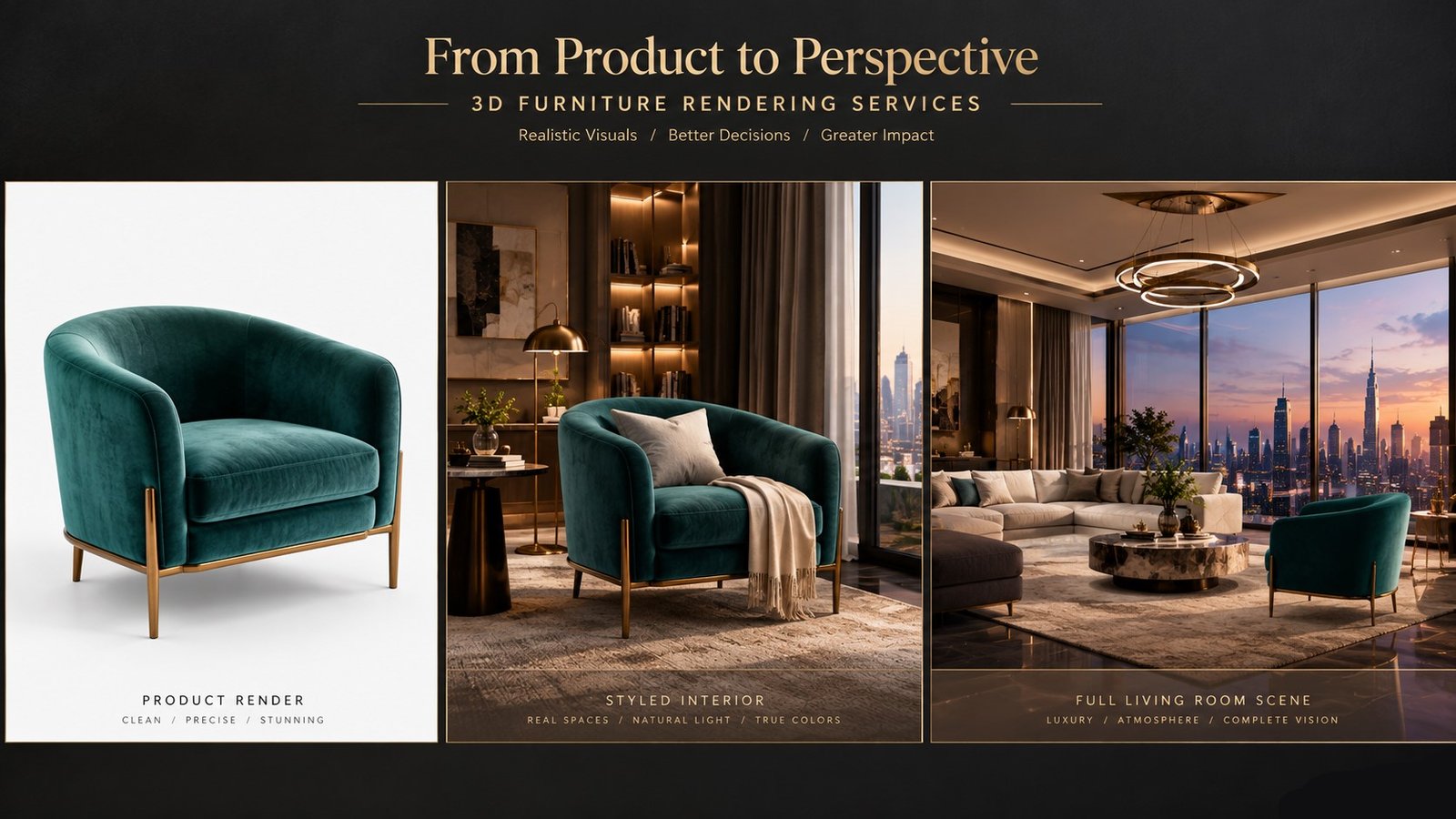
- 3D Furniture Lifestyle Rendering for styled room scenes that sell the look and feel.
- 3D Product Rendering for wider product categories such as decor, lighting and accessories.
- 3D Furniture and Product Animation for motion content, assembly stories and social video.
- Furniture and Product Modeling for AR for true-scale models that shoppers place in their room.
- 360 Product View for interactive spins on the product page.
- Low and High-Poly 3D Modeling for light web models and detailed hero models from one source.
The best value comes from reuse. A single accurate model can feed all seven outputs, so you avoid paying for the same geometry twice.
How Much Do 3D Furniture Rendering Services Cost in the USA?
Prices vary by studio and scope. Published 2026 ranges give a useful starting point.
| Output | Typical range | What moves the price |
| White-background image | $40–$150 | Product complexity, resolution |
| Lifestyle scene | $150–$500 | Scene detail, props, lighting |
| Premium hero image | $450–$1,200 | Custom materials, complex lighting |
| 360° or configurator asset | $500–$2,000 per product | Number of options and angles |
| Animation, AR model | Quoted per project | Length, detail, platform |
Treat these as planning numbers. A serious studio will quote your exact scope after it reviews your files.
What Changes the Price of a Furniture Render?
Five factors explain most quote differences.
- Source files: usable CAD files lower the modeling cost. Rebuilding from drawings raises it.
- Variants: the first model is the main expense. Each extra fabric or finish usually costs far less.
- Revisions: two or three rounds are often included. Extra rounds are billed separately.
- Turnaround: rush delivery commonly adds 25% to 50% to the base quote.
- Volume: larger batches lower the per-image rate because models and scenes get reused.
Volume matters most for furniture catalog rendering. A 50-product catalog quoted as one project usually costs less per image than 50 separate orders.
Should You Outsource Furniture Rendering or Build an In-House Team?
Most brands choose to outsource furniture rendering because it avoids hiring, software licenses and powerful hardware. You pay for output, not for idle capacity.
| Factor | Outsourced studio | In-house team |
| Setup | Start within days | Hiring and training take months |
| Cost model | Pay per project | Fixed salaries and software |
| Scaling | Add capacity on demand | Limited by team size |
| Best for | Seasonal or growing catalogs | Very large, constant volume |
Teams focused on furniture rendering for manufacturers USA often start outsourced, then keep a hybrid model as their catalog grows.
What Mistakes Do Buyers Make When Ordering Renders?
Most problems come from the brief, not the artist. Avoid these common errors.
- Comparing quotes with different scopes: one studio includes revisions and variants, while another does not.
- Skipping the test render: a small sample reveals style, accuracy and communication before you commit.
- Forgetting channel specs: images rebuilt later for a marketplace add cost and delay.
- Sending incomplete files: missing dimensions or swatches force guesswork and extra revision rounds.
- Ignoring reuse: paying for images only, when the same model could also serve 360° views and AR.
Fix these five points, and your quotes become easier to compare. Your final images also arrive closer to what you imagined.
How Do You Brief a Studio the Right Way?
A clear brief protects your budget. Send these items with your first request.
- Product files: CAD, 3D files or dimensioned drawings.
- Materials: fabric swatches, finish samples and colour codes.
- References: photos of the product and the style you want.
- Channel specs: image sizes, backgrounds and file formats for each platform.
- Quantity: number of products, variants and angles.
- Deadline: your launch date, so the studio can plan capacity.
How Do You Choose the Right USA Studio?
Compare studios on proof, not promises. Use this short checklist.
- Portfolio: look for furniture work similar to yours.
- Test render: request a sample of one product before a bulk order.
- Revision policy: confirm how many rounds the quote includes.
- File ownership: confirm you own the models and final images.
- Communication: check response speed and overlap with US working hours.
- Formats: confirm delivery in the sizes and formats your channels need.
A studio that answers these points clearly usually delivers smoothly. Vague answers often predict surprise fees later.
What Does a Typical Project Timeline Look Like?
The following is an illustrative example, not a named client project. A furniture brand wants 20 products ready for a new website and a marketplace listing.
Week one covers file review and a test render. Weeks two and three cover modeling and the first full batch. Revisions and final delivery follow. Small batches commonly finish in one to three weeks, while large catalogs take four to eight weeks.
The brand then reuses the same models for lifestyle scenes and 360° views. That second wave costs less, because the geometry already exists.
Frequently Asked Questions
What are 3D furniture rendering services?
They are services that turn CAD files, drawings or samples into photoreal furniture images, 360° views, animations and AR models. A studio builds an accurate 3D model, adds materials and lighting, and renders the final visuals without a physical photo shoot.
How much do 3D furniture rendering services cost in the USA?
Published 2026 market ranges run about $40 to $150 for a white-background image and $150 to $500 for a lifestyle scene. Complex hero images, 360° views and animation cost more. Your exact quote depends on files, variants, revisions and deadline.
What image size does Amazon require for furniture listings?
The main image needs a pure white background, and the product should fill about 85% or more of the frame. Also, the longest side should be at least 1,000 pixels to enable zoom, while many sellers use 2,000 pixels or more. However, always confirm current rules on the platform.
What image size works best for Shopify product pages?
Most guides recommend a square image of 2048 × 2048 pixels. Also, keep file sizes small for fast loading, and use one consistent ratio across your whole catalog so the store looks uniform.
Is 3D rendering cheaper than furniture photography?
For catalogs with many variants, it often is. You pay for the model once, then change fabrics and finishes digitally. Photography needs a new setup for every variant, and it also needs a physical sample.
Do I need a physical sample to start?
No. A studio can work from CAD files, dimensioned drawings, photos and fabric swatches. Physical samples help with material accuracy, but they are not always required.
How long does a furniture rendering project take?
Small batches commonly take one to three weeks, while large catalog projects often take four to eight weeks. Also, rush delivery is possible but usually adds to the quote.
Can the same 3D model be used for AR and 360° views?
Yes. A master model can support still images, 360° spins, animation and AR. The studio creates lighter versions for web and mobile, so you avoid paying for the same geometry twice.
Conclusion
The right studio is not simply the cheapest one. It is the one that matches your specs, explains its pricing and builds models you can reuse.
Good rendering is an investment in assets, not a one-time expense. Each model you approve keeps working for you across your website, marketplaces, ads and AR experiences.
Start with your channel requirements. Send clean files. Ask for a test render, and compare quotes on scope rather than headline price.
Ready to plan your catalog? Blue Ribbon 3D builds photoreal images, 360° views, animation and AR models from one accurate master model.
Get Your Free SampleRequest a free sample render for one of your products. Contact us here to get started. |
Related posts
Furniture AR Modeling: How View-in-Room Cuts Returns (2026 Guide)
Introduction Furniture AR Modeling turns a product page into a fitting room for the home. A shopper t …

How 3D Furniture Configurators Help Customers Customize Products Before Buying
Introduction Choosing a sofa used to mean picking from whatever fabric and color the catalog photo ha …