Introduction
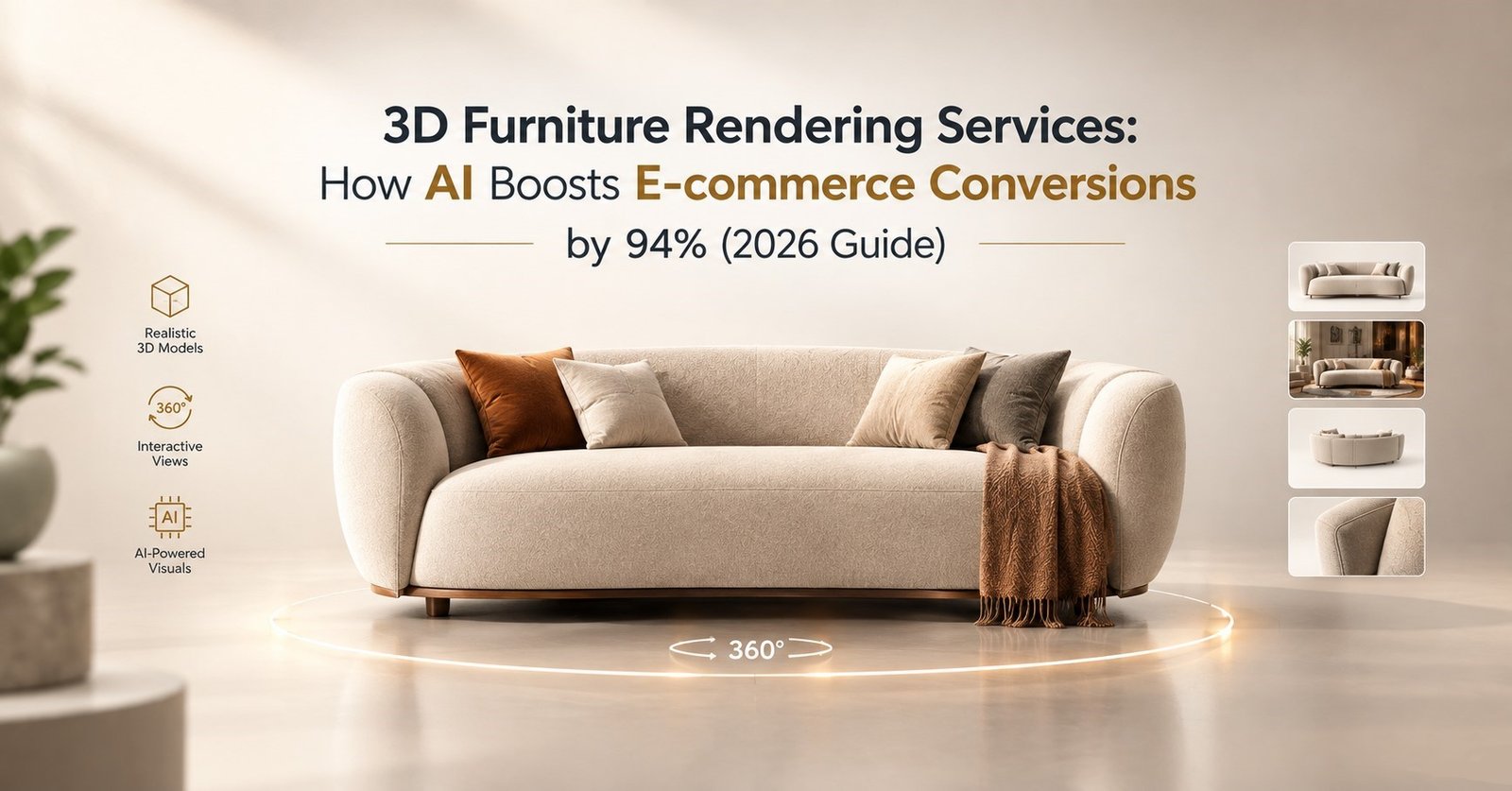
Furniture shoppers no longer buy from a single static photo alone. AI 3D Furniture Rendering now sits behind some of the biggest conversion gains reported anywhere in e-commerce, and the numbers are big enough that most brands can’t afford to ignore them going into 2026.
The headline figure — a 94% average conversion lift — comes from Shopify’s own merchant data, and it holds up across multiple independent reports on 3D Furniture Visualization. But the number needs context, not just repetition, which is exactly what this guide provides.
At Blue Ribbon 3D, we build AI-assisted 3D furniture assets for brands chasing exactly this kind of lift. This guide breaks down where the 94% figure actually comes from, how AI changes the rendering workflow, and how to start using it on your own catalog.
Direct AnswerAI 3D furniture rendering boosts e-commerce conversions because it lets shoppers rotate, zoom, and preview a product interactively instead of viewing a single static photo. Shopify’s own merchant data shows an average 94% conversion lift for stores using 3D content, and AI now speeds up the model-building process that used to take days down to hours. |
Key Takeaways
- Shopify reports a 94% average conversion lift for merchants using 3D content — a platform-level aggregate, not a guarantee for every product.
- AI speeds up 3D model creation, cutting build time from days to hours in many workflows.
- Interactive formats (3D, AR, configurators) consistently outperform static 2D images on engagement and conversion.
- Real brand case studies range widely — from a 7% lift to a 134% AOV increase — so results vary by product complexity.
- 3D content also reduces returns, since shoppers see accurate scale, texture, and fit before buying.
At a Glance: AI 3D Rendering Impact in 2026
| Metric | Reported Impact |
| Average conversion lift (Shopify merchant data) | Up to 94% |
| 3D content interaction rate | 82% of viewers activate it |
| Return reduction from 3D/AR content | Up to 40% on average |
| AI model build time vs. traditional | Hours instead of days |
| Shopper preference for 3D over static video | 95% |
What Is AI 3D Furniture Rendering?
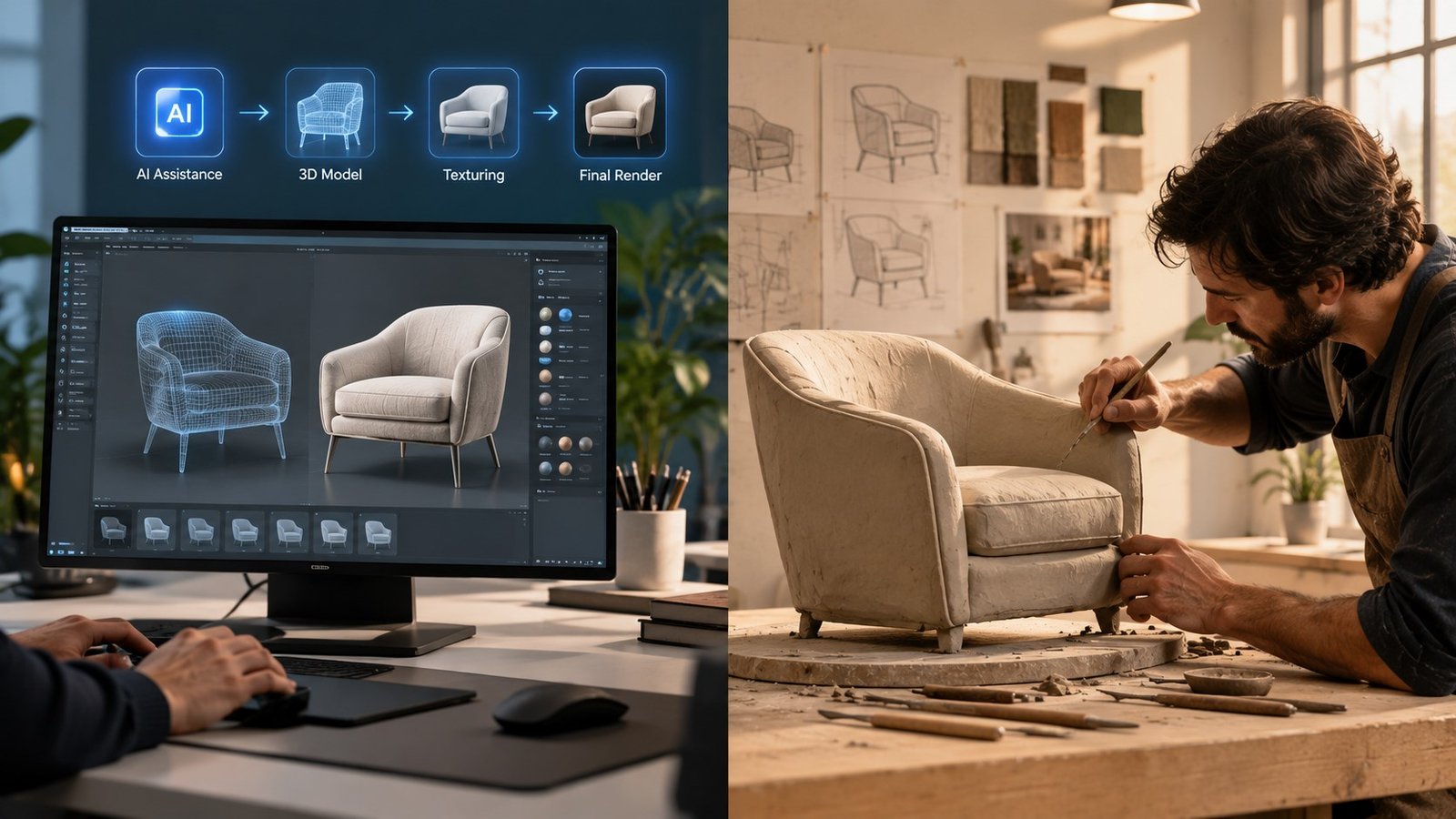
AI 3D furniture rendering combines traditional 3D modeling with AI-assisted steps that speed up parts of the pipeline — texture generation, lighting adjustment, and even converting reference photos into a rough 3D base model.
The output still goes through human review and refinement, but AI removes much of the repetitive manual work that used to make 3D projects slow and expensive.
The result is the same kind of interactive, rotatable product view shoppers now expect, just produced faster and often at a lower cost than a fully manual 3D pipeline.
This matters most for furniture specifically, because catalogs are large and product variations are constant — a new fabric option or leg finish used to mean scheduling an entirely new photo shoot. AI-assisted 3D removes that bottleneck almost entirely.
How Does AI 3D Furniture Rendering Work?
For online stores specifically, 3D Furniture Visualization for E-commerce usually follows four stages, with AI accelerating at least two of them.
- Capture or import: reference photos, CAD files, or dimensions feed into the pipeline as a starting point.
- AI-assisted modeling: software generates a rough 3D base shape, which an artist then refines for accuracy.
- Texturing and lighting: AI tools help match materials and lighting to reference photos faster than manual texturing alone.
- Export and deploy: the finished asset exports into stills, 360° views, AR files, or a configurator-ready format.
Benefits of AI 3D Furniture Rendering for E-commerce
Beyond raw conversion numbers, AI Product Visualization changes how a furniture brand operates its entire visual production pipeline.
- Faster turnaround: AI-assisted steps cut production time significantly compared to a fully manual 3D workflow.
- Lower cost per asset: less manual labor per model means studios can often price AI-assisted projects more competitively.
Better Furniture Product Visualization Services: brands get consistent, interactive product views across an entire catalog instead of a handful of hero shots.
- Fewer returns: industry reporting shows 3D and AR content can cut returns by up to 40% on average, since shoppers see accurate scale and detail upfront.
Taken together, these benefits compound. Lower production cost means more of the catalog can afford 3D treatment, which means more products benefit from the conversion and return advantages — a cycle that pure static photography can’t replicate at the same scale.
AI-Assisted Rendering vs. Traditional 3D Rendering
Not every project needs the fastest option. Here’s how AI 3D Product Rendering compares to a fully manual traditional pipeline.
| Factor | AI-Assisted Rendering | Traditional Manual Rendering |
| Typical build time | Hours to 1–2 days | 3–7+ days per model |
| Cost per model | Often lower | Higher, more manual hours |
| Best for | High-volume catalogs, fast iteration | Hero pieces needing maximum precision |
| Revision speed | Fast — AI reprocesses quickly | Slower — manual rework needed |
| Human oversight | Still required for final quality | Full manual control throughout |
3D Furniture Configurators and AR Furniture Visualization
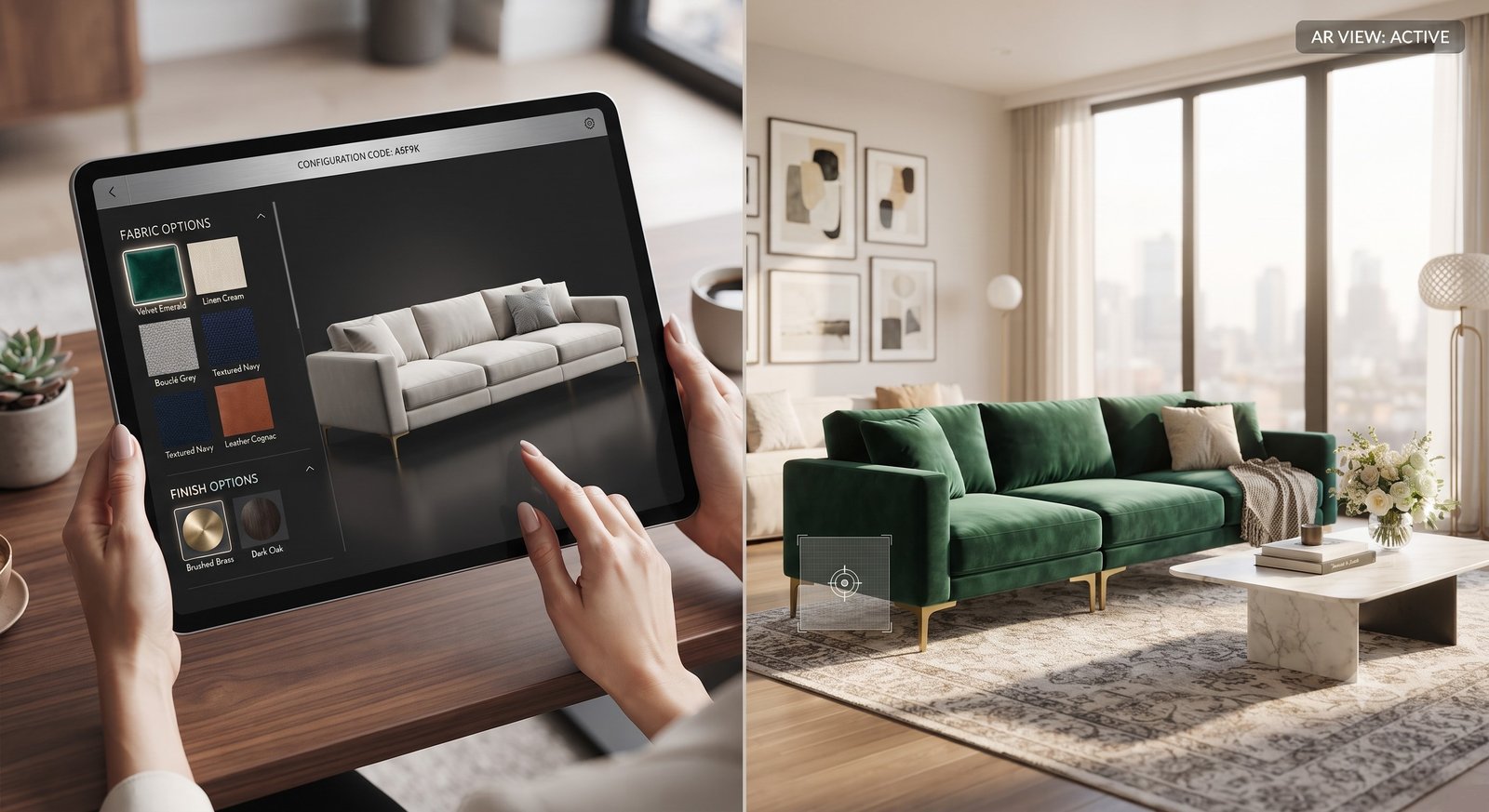
The most interactive layer on top of any 3D asset is a 3D Furniture Configurator, which lets shoppers change fabric, finish, or size directly on the product page and see the result instantly.
Paired with AR Furniture Visualization, shoppers can place that configured piece directly into their own room using a smartphone camera before they buy — combining customization and spatial confidence in one interaction.
One widely cited example: a pet-product brand added AR sizing to its Shopify store so shoppers could place a 3D model next to their pet before buying, which reduced that product’s return rate by about 5%. Modest on its own, but meaningful at scale in a category where returns are already a major margin problem.
Where Does the 94% Conversion Number Actually Come From?
This figure gets repeated often, so it’s worth being precise about the source. AI 3D furniture rendering for e-commerce case data traces back to Shopify’s own merchant-level reporting: stores that add 3D and AR content see a 94% higher conversion rate on average compared to stores without it.
It’s important to treat this as a directional benchmark rather than a guarantee. As one industry analysis of the underlying Shopify merchant data points out, it’s a platform-level aggregate, not a controlled experiment, and Shopify has not published the full methodology behind the figure.
Individual brand results vary widely. Some furniture and home goods brands report gains in the range of 7% to over 100%, depending on product complexity, category, and how the 3D content is implemented. The pattern holds directionally — interactive content outperforms static images — even though the exact percentage will differ from one catalog to the next.
The safest way to use this figure is as a hypothesis to test, not a number to promise stakeholders. Run a pilot, measure your own catalog’s actual lift, and let that number — not Shopify’s aggregate — guide your rollout budget.
Real Case Studies: 3D and AR in Furniture E-commerce
A few publicly reported examples put the numbers into context beyond the single headline figure.
DFS, the UK’s largest sofa retailer, digitized more than 10,000 product variants using 3D visualization and AR, letting shoppers customize fabric and leg options and preview the configured sofa in their own room. According to the reported case study, similar configurator implementations have driven conversion increases well above 100% for complex, customizable products specifically.
Results at this scale aren’t universal — smaller or simpler product lines tend to see more modest single-digit-to-double-digit gains — but the direction is consistent across the furniture category specifically, which tends to benefit more than simpler product types because shoppers care so much about scale, fabric, and fit.
How to Get Started With AI 3D Furniture Rendering Services
Most brands don’t convert an entire catalog on day one. Reputable 3D Furniture Rendering Services providers typically recommend starting with a pilot batch.
- Start with 10–20 bestselling or highest-return products
- Measure conversion and return-rate change over 4–6 weeks
- Add AR or configurator features to the pilot set before scaling
- Expand to the full catalog once the pilot data supports it
Track the same metrics Shopify’s own aggregate is built from — conversion rate and return rate, before and after — so you have a defensible, catalog-specific number to bring back to stakeholders rather than relying on an industry-wide average.
Frequently Asked Questions
What is AI 3D furniture rendering?
It combines 3D modeling with AI-assisted steps — like rough shape generation and faster texturing — to produce interactive, rotatable furniture visuals faster than a fully manual pipeline, without skipping the human quality review.
Is the 94% conversion boost guaranteed for every brand?
No. It reflects Shopify’s average merchant data across many stores, not a controlled study. Individual results vary based on product complexity, category, and how well the implementation is executed.
How does AI speed up 3D rendering?
AI tools can generate a rough base model from reference photos, assist with texture matching, and speed up lighting adjustments, cutting build time from days to hours in many cases while still needing artist review.
Does AI 3D rendering replace human artists?
No. AI speeds up repetitive steps, but artists still refine accuracy, materials, and final quality before an asset ships to make sure it matches the real product.
What’s the difference between a 3D configurator and AR?
A configurator lets shoppers customize a product’s options, such as fabric, finish, or size, on screen. AR goes a step further and places that configured product virtually in the shopper’s actual room using their camera.
Does 3D rendering really reduce returns?
Industry data suggests it can, often by meaningful margins, since accurate scale and material detail set clearer buyer expectations before checkout, which is one of the most common levers for cutting mismatch-driven returns.
How long does an AI-assisted 3D furniture model take?
Many AI-assisted builds finish in hours to a day or two, compared to three to seven-plus days for a fully manual model, though complex pieces with intricate upholstery can still take longer.
Can small furniture brands use AI 3D rendering affordably?
Yes. Because AI reduces manual hours per model, many studios can offer more competitive per-product pricing than a fully manual 3D pipeline, making it accessible even for smaller catalogs.
Conclusion
The 94% figure behind AI 3D furniture rendering is real, sourced, and worth paying attention to — but it’s a directional benchmark, not a promise. What’s consistent across every report and case study is the direction: interactive, AI-assisted 3D content outperforms static images, often by a wide margin, especially in a visually driven category like furniture.
The brands seeing the biggest gains aren’t chasing the headline number. They’re piloting on their highest-impact products, measuring real results, and scaling from there.
As AI continues to compress production timelines, the gap between brands using interactive 3D and brands still relying on static photography alone is likely to widen further heading into 2026 and beyond.
Ready to see what AI-assisted 3D rendering could do for your own catalog? Blue Ribbon 3D builds AI-assisted furniture visuals designed for exactly this kind of pilot-to-scale rollout.
Related posts
Furniture 3D Rendering Cost in 2026: Complete Pricing Guide
Introduction If you are planning a furniture catalog shoot for 2026, furniture 3D rendering cost is p …
3D Furniture Rendering: How Furniture Brands Are Using 3D Visualization to Sell Online in 2026
Introduction Furniture brands no longer rely only on studio photography to sell online. 3D Furniture …