Introduction
Online furniture shopping has a trust problem. Buyers can’t sit on a sofa through a screen. They can’t check how a finish looks under real light.
This is why 3d furniture rendering services have become standard for US brands in 2026. Photorealistic 3D images solve the trust gap that photography alone can’t fix.
At Blue Ribbon 3D, furniture brands ask us the same question every week: does 3D rendering actually improve sales? The short answer is yes. This guide explains why, and how to get started.
We’ll cover the shift happening in the furniture industry right now. You’ll see real cost comparisons, and learn how to pick the right rendering partner for your catalog.
This isn’t a small trend. Major retailers and small independent furniture brands are both making the switch. The reasons differ slightly by company size, but the underlying math is the same: better visuals, lower costs, faster launches.
Quick Answer
| US furniture brands are adopting 3D furniture rendering services in 2026 because it cuts photography costs by up to 70%, speeds up catalog updates, and lets shoppers view products from every angle. This directly reduces returns and increases online conversion rates. |
What Is 3D Furniture Rendering?
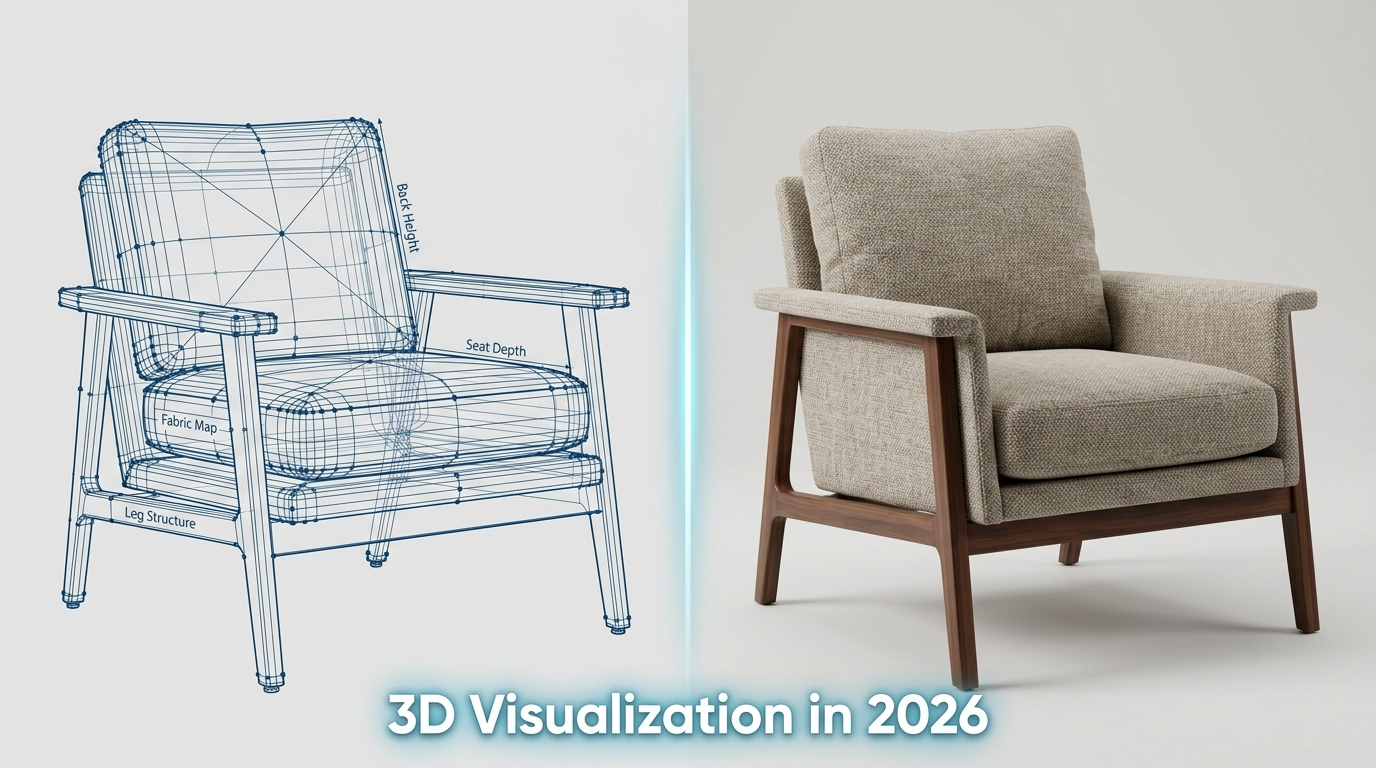
3D furniture rendering builds a digital model of a furniture piece. Artists then add real materials, textures, and lighting to make it look photorealistic.
The result looks like a studio photograph. But no physical product, photographer, or studio space is needed to produce it.
Once a piece is modeled, brands can reuse it endlessly. Change the fabric color, camera angle, or room setting without a new photo shoot.
This single advantage is reshaping how furniture brands manage their entire product catalog.
The technology behind this has matured quickly. Rendering engines now simulate how light bounces off fabric, wood grain, and metal finishes with striking accuracy. A well-lit render can be nearly impossible to distinguish from a real photo at normal viewing size.
This matters because shoppers trust what looks real. A flat, obviously artificial render can hurt a brand’s credibility rather than help it. Quality of execution is everything in this space.
Why U.S. Furniture Brands Are Making the Shift in 2026
Several forces are pushing brands toward 3D visualization this year. Here are the biggest ones.
1. Photography Costs Keep Rising
Traditional furniture photography needs a studio, a photographer, and physical samples of every color and fabric option. Costs add up fast across a large catalog.
A 3d furniture rendering company eliminates most of this. One digital model replaces dozens of physical photo shoots.
Studio rental alone can run $500–$1,500 per day in major US cities. Add photographer fees, styling, and post-production editing, and a single day’s shoot can easily exceed $3,000 for a handful of products.
3D rendering shifts this cost structure entirely. The heavy investment happens once, during modeling. After that, producing new angles or color variants costs a fraction of the original setup.
2. Shoppers Expect Interactive Views
Today’s shoppers want to rotate a product, zoom in, and see it in different colors. Static photos can’t deliver this experience.
3D rendering makes 360° product views possible. Shoppers explore a sofa from every angle, just like in a showroom.
This expectation didn’t exist five years ago. It’s grown alongside the rise of AR shopping features on major retail apps, where customers can even preview furniture in their own living room using their phone camera.
Brands without this capability increasingly look outdated next to competitors who offer it, even if the actual furniture quality is comparable.
3. New Product Launches Move Faster
Physical samples take weeks to manufacture before a photo shoot can even happen. A 3D model can be ready before the first physical unit rolls off the production line.
This means brands can list new furniture online the same day it’s announced, not weeks later.
This speed advantage compounds during high-demand seasons. A brand launching a new collection ahead of the holiday shopping season can start marketing and pre-selling well before inventory physically exists.
4. Returns Are a Growing Cost Problem
Furniture returns are expensive. Bulky items cost more to ship back than smaller products.
Accurate 3D visuals set correct expectations. Shoppers see true scale, color, and texture before buying, which reduces mismatched-expectation returns.
Return logistics for large furniture items often involve freight shipping, restocking fees, and sometimes total write-offs if the item gets damaged in transit. Every prevented return has an out sized impact on profit margin compared to smaller retail categories.
5. AI Tools Have Made 3D Rendering Faster
AI-assisted rendering pipelines have cut production time significantly since 2024. What once took a week per product now takes days.
This speed makes 3D rendering practical even for brands with catalogs of thousands of SKUs.
AI tools now handle repetitive tasks like initial lighting setup and texture matching automatically. Human artists then focus on fine-tuning realism, rather than starting each product from a blank scene.
How 3D Visualization Improves Online Shopping
Better visuals do more than look nice. They directly affect buying behavior. Here’s how:
- Higher conversion rates from more accurate, detailed product views
- Lower return rates due to realistic scale and material representation
- Faster catalog updates without new photo shoots for every variant
- Consistent lighting and styling across the entire product catalog
- Easier A/B testing of room settings, colors, and camera angles
Each of these compounds over time. A brand with 500 products saves enormous photography costs by year two.
Consistency deserves special attention. When every product photo comes from a different shoot, lighting and color grading can vary slightly. Shoppers browsing a full catalog notice this inconsistency, even subconsciously.
3D rendering solves this by using the same lighting rig and camera settings across an entire collection. The result is a catalog that feels professionally unified, page after page.
A/B testing also becomes dramatically easier. Marketing teams can test a sofa in a beach-house setting versus a city apartment setting without scheduling a new shoot for each scene. This kind of rapid experimentation was previously reserved for only the largest retail budgets.
3D Furniture Rendering vs. Traditional Photography
| Factor | Traditional Photography | 3D Rendering |
| Cost per product | $200–$800+ | $50–$250 |
| Color variants | New shoot per color | Instant re-render |
| Turnaround | 1–3 weeks | 2–5 days |
| Sample product needed | Yes | No |
| 360° view support | Limited, costly | Native, low extra cost |
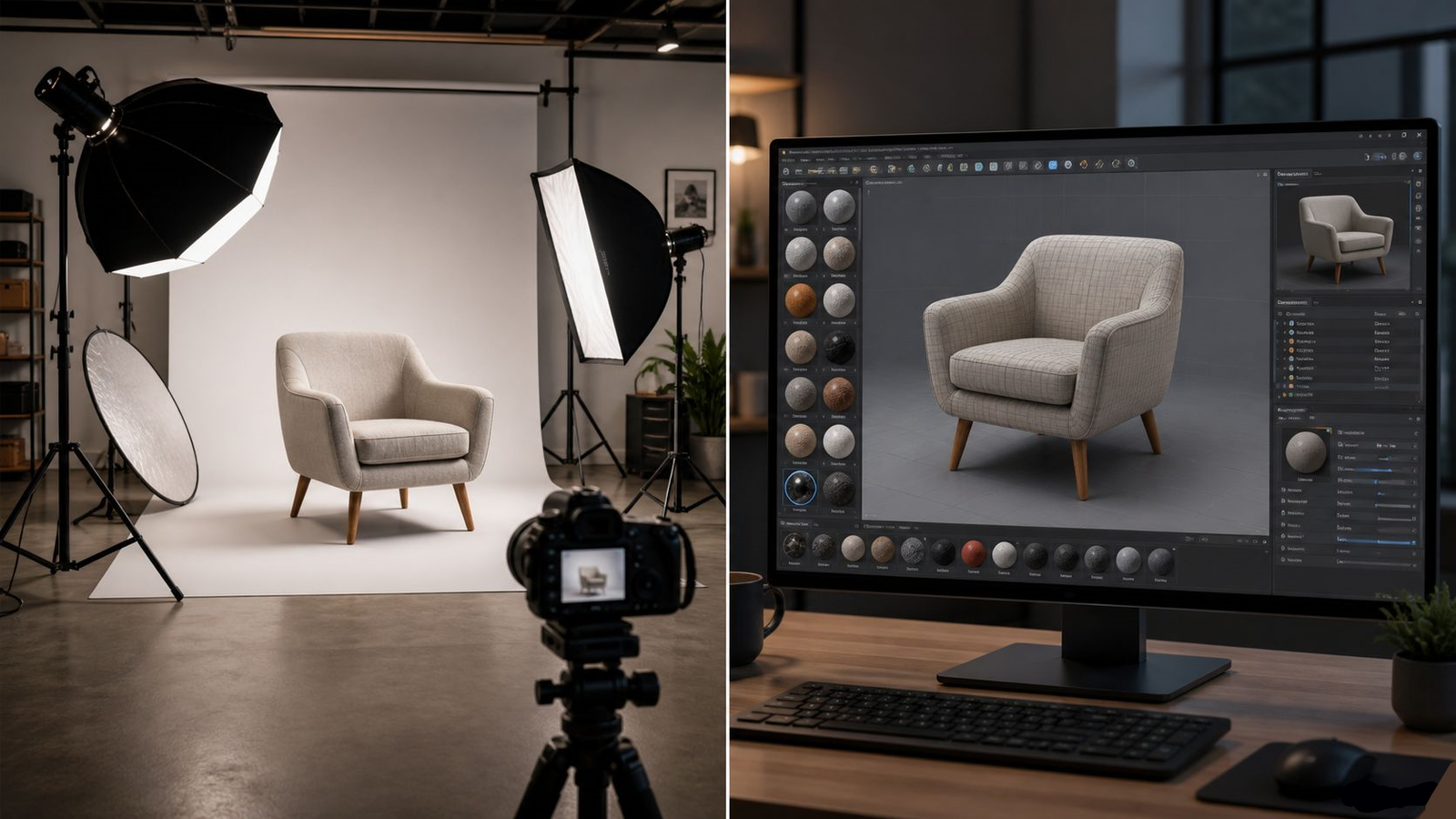
The gap widens further at scale. A catalog of 50 products sees moderate savings. A catalog of 5,000 products sees transformational savings.
There’s also an environmental angle worth mentioning. Physical photo shoots involve shipping sample products, sometimes across the country, then storing or disposing of them afterward. 3D rendering eliminates this physical logistics chain almost entirely.
Some brands now highlight this reduced footprint in their sustainability messaging, turning a cost-saving decision into a marketing point as well.
How Much Do 3D Furniture Rendering Services Cost?
Pricing depends on model complexity, texture detail, and how many angles or colorways you need.
- Basic single-angle render: $50–$100 per product
- Multi-angle render (4–6 views): $100–$200 per product
- Full 360° interactive render: $150–$300 per product
- Lifestyle scene rendering (product in a styled room): $200–$400 per scene
Most studios offer volume discounts. A catalog of 100+ products often gets 20–30% off standard per-unit pricing.
It’s worth budgeting slightly more for your bestsellers. Spending extra on a flagship product’s rendering quality pays off disproportionately, since these items typically drive the majority of catalog traffic.
Finding the Best 3D Furniture Rendering Services
Quality varies a lot between providers. When comparing best 3d furniture rendering services, check these details first.
- Material accuracy — does fabric texture look real up close?
- Lighting consistency across your entire catalog
- Turnaround time for large batch orders
- Revision policy if a color or texture doesn’t match your sample
A professional 3d furniture rendering company should also show you a sample render before you commit to a full catalog project. This is the fastest way to judge quality.
Ask specifically to see fabric close-ups in the sample. Fabric texture is where cheaper rendering tools tend to fall short, often looking slightly plastic or overly smooth compared to real material.
3D Furniture Rendering Services USA: What to Expect in 2026
Search interest in 3d furniture rendering services USA has grown steadily as more brands move catalogs fully online.
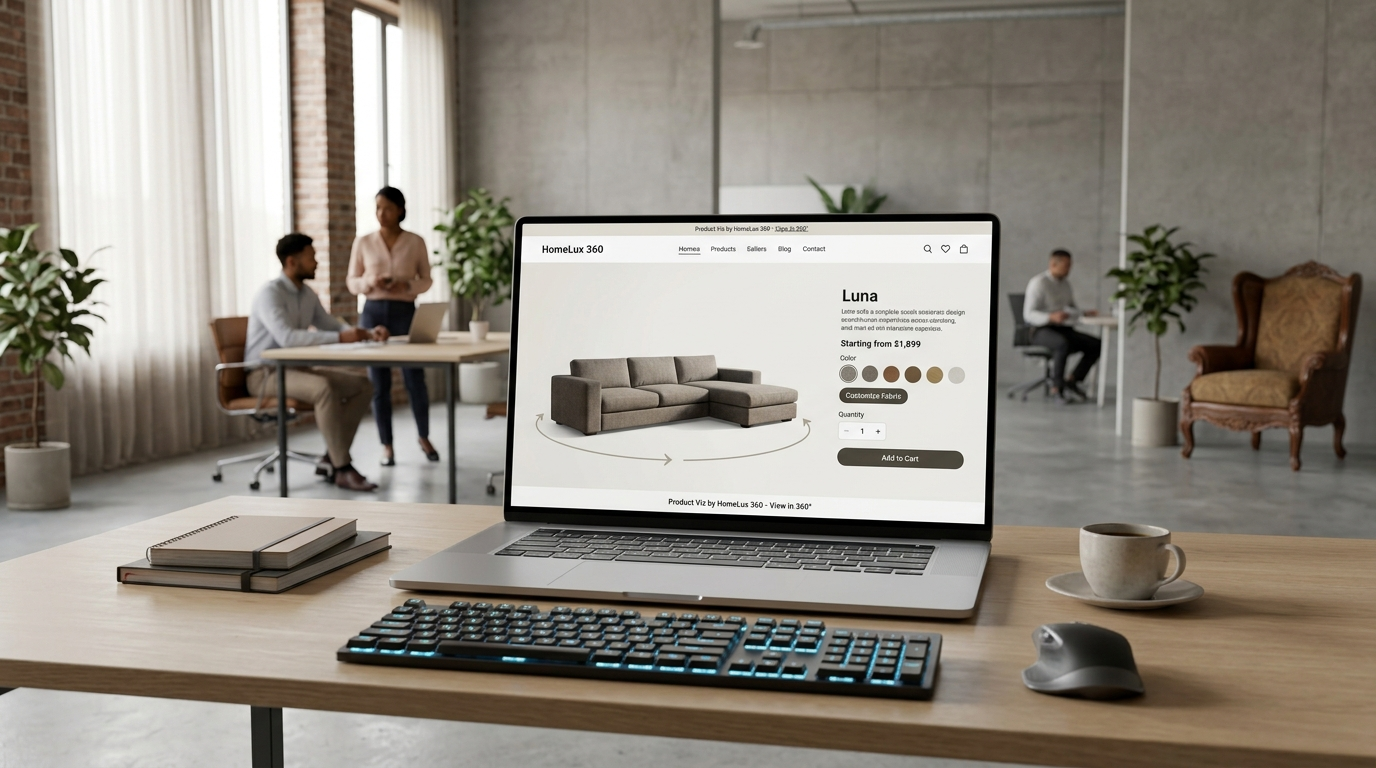
Most US-facing studios now offer hybrid production. Client communication happens in US time zones. Rendering work often happens overseas, which keeps pricing competitive.
This hybrid model has made furniture 3d rendering USA services accessible even for smaller, independent furniture brands, not just large retailers.
If your brand needs consistent studio-quality visuals without studio-scale costs, Blue Ribbon 3D’s product visualization team works directly with furniture brands to build reusable 3D asset libraries.
The Role of AR in Furniture Shopping
Augmented reality builds directly on 3D rendering work. Once a furniture piece has an accurate 3D model, that same model can power an AR “view in your room” feature.
Shoppers point their phone camera at their living room. The app places a true-to-scale digital sofa right there on the screen.
This feature has measurably reduced hesitation at checkout for many retailers. Buyers feel more confident about size and fit, which matters enormously for large furniture purchases.
Brands that already invest in 3D rendering have a head start here. The same model built for product photos can be reused for AR, with only minor optimization needed.
Brands starting from scratch with photography alone face a much bigger technical gap to add AR features later.
Sustainability and 3D Rendering
Furniture brands increasingly market their sustainability efforts. 3D rendering quietly supports this goal in ways many brands don’t advertise.
Physical photo shoots involve shipping sample products across the country. Sometimes samples get shipped internationally for photography in specific studios.
Each shipment carries a carbon cost. Rendering eliminates most of this movement, since the same digital file can be used and reused from anywhere.
There’s also a waste reduction angle. Physical samples used only for photography often get discarded or heavily discounted afterward. Digital models never become physical waste.
Some brands have started including this efficiency in their sustainability reporting, positioning 3D visualization as both a cost-saving and environmentally responsible choice.
Industry Outlook: What to Expect Beyond 2026
The furniture industry’s shift to 3D isn’t slowing down. Several trends point to even deeper adoption ahead.
- Wider adoption of AI-generated lifestyle scenes tailored to shopper preferences
- Growth in AR try-before-you-buy features across mid-size retailers, not just large ones
- Increased use of 3D assets in social media advertising and video content
- More retailers building permanent, reusable 3D asset libraries instead of one-off renders
Brands that build a solid 3D asset library now will find it easier to adopt each of these newer capabilities as they arrive.
In-House vs. Outsourced 3D Rendering Teams
Brands face a choice once they commit to 3D visualization. Build an in-house team, or outsource to a specialized studio.
In-house teams offer tight control. Your artists sit next to your marketing team. Feedback loops are fast.
But in-house teams are expensive to build. You need skilled 3D artists, rendering software licenses, and powerful workstations. Hiring alone can take months.
Outsourced studios skip this setup entirely. You pay per project or per product, with no fixed overhead.
This makes outsourcing the practical choice for most furniture brands, especially those still testing whether 3D visualization fits their catalog.
Larger brands sometimes use a hybrid model. A small in-house team handles quick updates. An outsourced studio handles large seasonal catalog refreshes.
Whichever path you choose, keep your 3D asset files. These base models are reusable for years, regardless of who renders them next.
Building a Reusable 3D Asset Library
The real long-term value of 3D rendering isn’t the first image. It’s the reusable model behind it.
A well-built 3D model becomes a permanent brand asset. Update the fabric next season. Change the room setting for a new campaign. The base model stays useful for years.
Brands that treat 3D models as disposable, one-time deliverables miss this value. Always request the source files, not just the final rendered images.
Store these files in an organized library, tagged by product line and creation date. This makes future updates fast, instead of starting from scratch each time.
Measuring the ROI of Your 3D Rendering Investment
Track a few key metrics after switching a product’s images to 3D. This tells you if the investment is paying off.
- Conversion rate on the product page, before and after the switch
- Return rate for that specific product over the following months
- Time spent on the product page, an indicator of shopper engagement
- Add-to-cart rate compared to similar products still using photography
Give the data at least four to six weeks to stabilize. Early spikes or dips can be noise rather than a real trend.
Most brands see conversion improvements within the first month. Return rate improvements often take longer to show clearly, since returns lag behind the original purchase by weeks.
Document these results per product category. Rendering may perform differently for sofas than for smaller accent pieces, and understanding this helps you prioritize future catalog investments.
Common Mistakes Brands Make With 3D Furniture Rendering
A few avoidable mistakes can undercut the value of switching to 3D visuals.
- Skipping fabric texture samples, leading to inaccurate material rendering
- Not planning for future color variants during the initial model build
- Using inconsistent lighting between rendered and photographed products
- Choosing the cheapest provider without checking sample quality first
Planning ahead for variants saves money. Building color flexibility into the base model costs less than remodeling later.
Another common mistake is mixing rendered and photographed images on the same product page without matching lighting styles. This inconsistency confuses shoppers and can make the rendered images look noticeably fake by comparison.
It helps to fully commit to one approach per product line, at least until your team has enough experience to blend both seamlessly.
How to Start Your First 3D Rendering Project
Starting small works well. Pick 10–20 bestselling products first. Test how 3D visuals affect conversion before committing your full catalog.
Provide the studio with accurate dimensions, fabric swatches, and reference photos. This speeds up the modeling process significantly.
Once you see results on your top sellers, scaling to the rest of your catalog becomes a straightforward decision.
Set a clear timeline with your rendering partner before starting. Most studios can turn around a pilot batch of 10–20 products within one to two weeks, giving you real conversion data within a month of starting the project.
Track your conversion rate and return rate before and after switching each product’s images. This data becomes your strongest internal case for expanding the rollout across your full catalog.
Frequently Asked Questions
What is 3D furniture rendering used for?
3D furniture rendering creates photorealistic product images without a physical photo shoot. Brands use it for e-commerce listings, marketing, social media content, and interactive 360° product views that boost buyer confidence.
How much does 3D furniture rendering cost?
Pricing typically ranges from $50 to $400 per product, depending on the number of angles, color variants, and whether lifestyle scenes are included. Volume discounts often apply for larger catalogs.
Is 3D rendering as accurate as real photography?
Yes, when done by an experienced studio. Photorealistic rendering matches real material texture, lighting, and scale closely enough that most shoppers can’t tell the difference from an actual photograph.
Can 3D rendering show multiple fabric colors?
Yes. Once a furniture piece is modeled, changing fabric color or material is fast and doesn’t require a new photo shoot or physical sample, unlike traditional photography.
Do I need a physical product sample for 3D rendering?
No. Studios can build accurate models from technical drawings, dimensions, and material swatches alone, which is ideal for pre-launch products that don’t exist physically yet.
How long does furniture 3D rendering take?
A single product typically takes 2–5 days. Full catalog projects take longer, but most studios can batch-process large orders efficiently once the first few models are approved.
Does 3D rendering help reduce furniture returns?
Yes. Accurate scale, color, and texture representation helps set correct buyer expectations, which reduces returns caused by product mismatch, one of the most common return reasons in furniture e-commerce.
What’s the difference between a 3D rendering company and a photography studio?
A photography studio shoots physical products with cameras and lighting equipment. A 3D rendering company builds and renders digital models, which can be reused and modified without new physical shoots, saving significant time and cost over a product’s lifecycle.
Can small furniture brands afford 3D rendering?
Yes. Outsourced studios charge per product, so small brands can start with just their bestsellers instead of committing to a full catalog upfront. This makes the technology accessible at almost any budget level.
Conclusion
2026 has become a turning point for furniture e-commerce. 3d furniture rendering services now cost less than traditional photography while delivering more flexibility.
Brands that adopt 3D visualization early gain a real advantage. Faster launches, lower photography costs, and better-informed buyers all compound over time.
The brands winning online in 2026 aren’t necessarily making better furniture than their competitors. Often, they’re simply presenting it better — with visuals shoppers can trust before they ever sit on the product in person.
That trust gap used to be furniture e-commerce’s biggest weakness. Today, it’s becoming one of its strongest advantages for brands that invest in it early.
Blue Ribbon 3D helps US furniture brands build reusable, photorealistic 3D catalogs at scale. Get a free quote for your product catalog here.
Related posts
Furniture 3D Rendering Cost in 2026: Complete Pricing Guide
Introduction If you are planning a furniture catalog shoot for 2026, furniture 3D rendering cost is p …
3D Furniture Rendering: How Furniture Brands Are Using 3D Visualization to Sell Online in 2026
Introduction Furniture brands no longer rely only on studio photography to sell online. 3D Furniture …