
Introduction
Most advice on furniture tariffs 3D renders starts with price. This guide starts with timing, because a tariff hurts most when you commit to a container before you know what will sell.
First, production takes time. Then ocean freight takes more. Meanwhile, rates can change, and your cash sits in a box at sea. As a result, many brands feel that gap more than the duty itself.
At Blue Ribbon 3D, we see a smart fix. Brands build photoreal 3D renders first, test demand online, and then order stock. So this article shows how that workflow protects cash and reduces risk.
| Quick Answer Furniture tariffs make every unsold unit more expensive, so brands now validate demand before they import. 3D renders let a US brand list new products, take pre-orders and compare variants before inventory lands. As a result, the brand orders only what customers have already chosen, and it limits tariff exposure on slow movers. |
Key Takeaways
- The inventory gap is the real risk, because rates can shift while goods are in transit.
- Landed cost includes duty, freight and fees, so a tariff change moves the whole total.
- Renders let you test colours and fabrics before you pay for any of them.
- Pre-orders need clear ship dates and honest terms to build trust.
- Always confirm current rates with a licensed customs broker before you price.
At a Glance: Tariff Snapshot (as of October 2026)
| Item | Reported status | What it means |
| Upholstered wooden furniture | 25% Section 232 duty for most origins | Higher cost on sofas and chairs |
| Scheduled increase | Moved to January 1, 2027 (30% for upholstered) | A second cost step is still ahead |
| Kitchen cabinets and vanities | 25% now, 50% scheduled for January 1, 2027 | Bigger jump for cabinet brands |
| Some trade partners | Lower caps, such as 10% for the UK and 15% for the EU and Japan | Origin changes the total |
What Do 2026 Furniture Tariffs Mean for US Brands?
The headline item is the upholstered furniture tariff. Most imported upholstered wooden furniture now faces a 25% Section 232 duty. The government postponed a planned rise to 30% until January 1, 2027.
However, other furniture categories follow different rules. Trade press also reports a separate Section 301 duty of 10% to 12.5% on many origins since late July 2026. The reports say items already covered by the 25% duty are generally excluded, but a legal challenge is pending.
That mix is confusing, because classification, country of origin and product type all matter. So the first step is simple: ask your broker which rate applies to each product.
Why Is the Inventory Gap the Real Problem?
Picture the timeline of a typical import order. First, you approve a design. Then the factory builds. Next, the goods ship, clear customs and reach a warehouse. Finally, they go on sale.
During those weeks, three things can go wrong. First, rates can change. Second, demand can shift. Third, your cash stays locked in stock that nobody has bought yet.
Tariffs raise the stakes on every one of those risks. A slow-selling sofa used to cost you shelf space. Now it also carries a duty bill, so a wrong guess is more expensive than before.
How Does Landed Cost Change the Math?
Smart brands track furniture landed cost, not just factory price. Landed cost is the full price of a product once it reaches your door, so it shows your real margin.
- Product cost: what you pay the factory.
- Freight and insurance: ocean or air transport to the US.
- Duty: tariffs and standard import duties, based on customs value.
- Fees and handling: customs processing, port charges and trucking.
- Storage: warehouse space until the product sells.
The example below uses simple, made-up numbers to show the arithmetic. It is not a quote or a market price.
| Illustrative sofa | At 25% duty | At 30% duty |
| Factory price | $400 | $400 |
| Duty on that value | $100 | $120 |
| Freight share (assumed) | $60 | $60 |
| Landed cost before fees | $560 | $580 |

How Do 3D Renders Let You Sell Before Stock Lands?

Photoreal renders make it possible to sell furniture before inventory arrives. A render looks like a photograph, but it needs no finished product. Instead, you only need the design files.
The workflow has five steps.
- Model: build an accurate 3D model from CAD files or the factory’s drawings.
- Render: create white-background and lifestyle images for every variant.
- Publish: launch the product page with a clear ship date.
- Measure: watch clicks, saves, pre-orders and questions.
- Order: place the purchase order based on real demand.
This order of work reverses the old habit. Instead of buying first and marketing later, you market first and then buy.
How Do You Run a Furniture Pre-Order Without Losing Trust?
A furniture pre-order works only when shoppers trust the promise. Customers will wait, as long as you are honest about the wait.
- State a ship window: give a clear date range and update it if it changes.
- Explain the terms: say what a deposit covers and how refunds work.
- Show the product honestly: make sure renders match the final item.
- Send updates: email buyers at each stage so they never wonder.
Also check the rules. In the US, sellers generally must ship by the promised date or offer buyers a way out, so ask a legal adviser to review your terms.
Which Products Should You Render First?
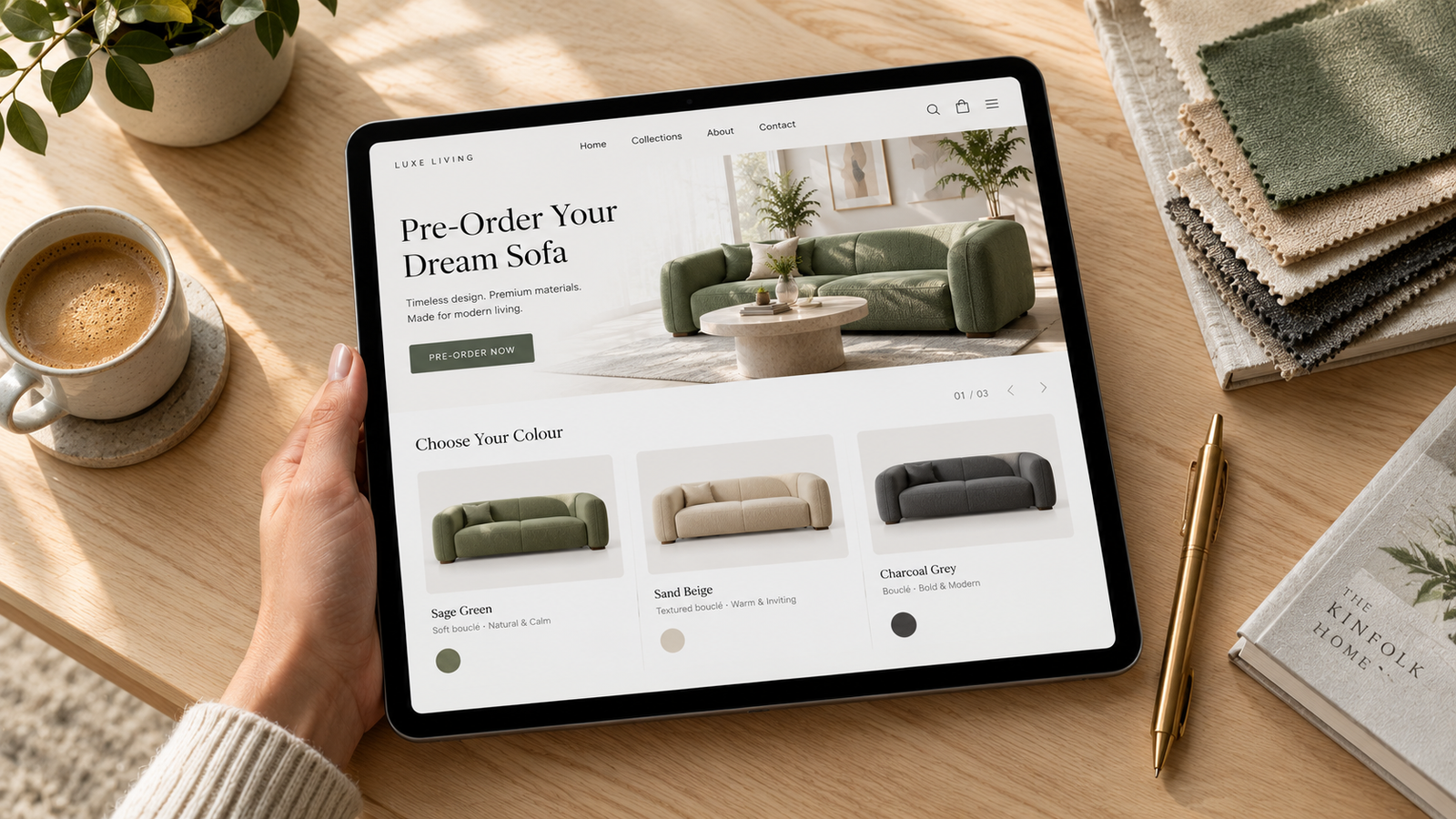
Start where tariffs hurt most. Upholstered pieces carry the highest duty, and fabric choices multiply fast. Therefore, test those first.
A studio offering 3D furniture rendering services can build every colourway from one master model. That is usually cheaper than sampling each fabric in real life.
Brands often call this work furniture CGI. Look at a studio’s portfolio first, because quality shows in fabric weave, stitching and light.
Accurate geometry matters too. Good 3D furniture modeling services give you a model you can reuse for images, 360° views and AR later.
How Should You Price When Rates Might Change?
Uncertainty makes pricing hard. If you price too low, a later increase eats your margin. If you price too high, shoppers leave.
Therefore, build a small buffer into each quote and review it often. Also, avoid hard promises about long-term prices, because rates can move. Instead, tell pre-order buyers exactly what the price covers.
Renders help here as well. Since you can update a product page in minutes, you can adjust options, bundles and finishes without reshooting anything. For example, you can swap a costly fabric for a cheaper one and show the result at once.
How Do You Keep Renders and Landed Cost in Sync?
A simple tracking sheet keeps decisions clear. List each product, its variants, the pre-orders so far and its estimated duty exposure.
| Column | What to record |
| Product and variants | Each colour and fabric you rendered |
| Demand signal | Clicks, saves and pre-orders per variant |
| Landed cost | Factory price, freight, duty and fees |
| Decision | Order, wait or drop the variant |
Review the sheet weekly. As soon as a variant shows weak demand, drop it before you place the order. Meanwhile, give extra attention to the strongest performers.
What Does a Demand-First Launch Look Like?
The following is an illustrative example, not a named client. A US brand plans a new sofa in four fabrics. Previously, it would order stock in all four.
This time, it renders all four options and opens pre-orders. After a few weeks, two fabrics get most of the interest. Then the brand orders those two only.
As a result, it avoids paying duty on two slow colourways. It also frees cash for the next launch. Of course, results vary by product and season. Still, the method keeps the brand in control, because it lets real demand guide each purchase order.
What Mistakes Should You Avoid?
Demand-first launches work well, but a few errors can undo the benefits.
- Overpromising dates: if you miss a ship window, trust drops fast.
- Showing unrealistic renders: because buyers compare the product with the image, accuracy matters.
- Ignoring the rate: if you never update landed cost, your margins can slip unseen.
- Skipping the broker: classification errors can change your duty bill.
Fix these four, and your launch runs much more smoothly. Also, remember that tariff rules keep changing. Therefore, check your rates before every new order, and record the date you checked. That habit protects you when your finance team asks how you priced a product.
How Do You Choose a Rendering Partner in the USA?
Speed matters in a tariff year, so many brands pick a partner for 3D furniture rendering USA projects. Check these points before you commit.
- Test render: ask for one sample product first.
- Turnaround: confirm delivery times for the first batch.
- Revisions: check how many rounds the quote includes.
- Communication: look for overlap with US working hours.
- File ownership: confirm you own the models and images.
Frequently Asked Questions
How do furniture tariffs affect 3D rendering strategy?
Tariffs raise the cost of every unsold unit, so brands want proof of demand before they import. 3D renders let a brand list and test products before inventory exists, which reduces the risk of ordering the wrong items.
What is the current tariff on upholstered furniture?
As of October 2026, most imported upholstered wooden furniture faces a 25% Section 232 duty. The government postponed a planned increase to 30% until January 1, 2027. However, rates vary by origin, so confirm with a customs broker.
What is furniture landed cost?
Landed cost is the total price of a product once it reaches your warehouse. It includes the factory price, freight, insurance, duties, fees and handling. Tracking it shows your true margin.
Can I sell furniture before it arrives from the factory?
Yes. Many brands publish renders and take pre-orders with clear ship dates. You must be honest about timing and refunds, and you should ship by the promised date or offer buyers a way out.
Do I need a finished product to create 3D renders?
No. A studio can build renders from CAD files, drawings, dimensions and fabric swatches. A physical sample helps with material accuracy, but it is not always required.
Are 3D renders accurate enough for pre-orders?
They can be, if the model matches the real specifications. Share exact dimensions and swatches with the studio, and approve final renders against the factory’s samples.
Which products should I render first?
Start with products that carry the highest duty or the most variants, such as upholstered sofas and chairs. These carry the most risk, so early demand data helps most.
Will 3D renders reduce my tariff bill?
No. Renders do not change the duty rate. They help you order fewer slow-selling units, so you pay duty only on stock that customers have already chosen.
Conclusion
Tariffs are a cost you cannot control, but timing is a risk you can. Brands that test demand before they import protect their cash and their margins.
First, model your best sellers. Next, render every variant and open pre-orders. Then order only what customers have chosen, and update your landed cost with current rates.
Ready to launch before your stock lands? Blue Ribbon 3D builds photoreal renders, 360° views and AR models from one accurate master model.
| Get Your Free Sample Request a free sample render for one of your products. Contact us here to get started. |
Related posts

3D Furniture Rendering Services USA: 2026 Buyer’s Guide to Specs and Pricing
Introduction Buying 3D furniture rendering services USA should feel simple. Send a product. Receive p …

Furniture AR Modeling: How View-in-Room Cuts Returns (2026 Guide)
Introduction Furniture AR Modeling turns a product page into a fitting room for the home. A shopper t …